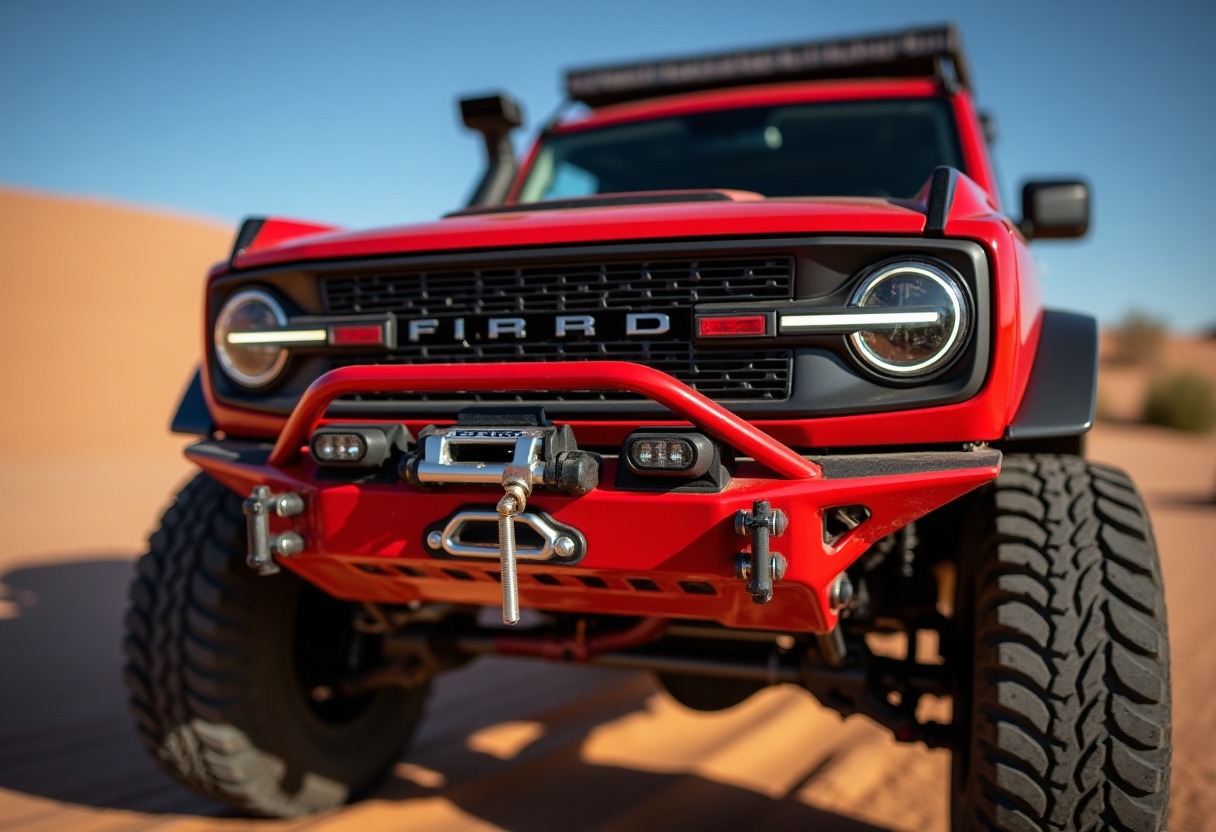
Factory Ford Bronco recovery points fail at 8,200 pounds — well below the vehicle's 5,200-pound curb weight multiplied by the 1.5 safety factor recovery experts recommend. Aftermarket options like Factor 55's FlatLink or Warn's Epic recovery shackles handle 38,000+ pounds, turning your Bronco into a legitimate recovery platform instead of a liability waiting to happen on the trail.
Why Factory Recovery Points Fall Short
Ford equipped the 2021+ Bronco with stamped steel recovery hooks rated at 8,200 pounds working load limit. The Society of Automotive Engineers establishes recovery point standards, but Ford's implementation prioritizes cost over capability. These hooks mount to thin frame extensions using three 10mm bolts, creating a weak link that concentrates stress on the mounting hardware rather than distributing load across the frame structure.
The factory hooks work fine for light pulls — freeing a Bronco from sand or mud with minimal resistance. But legitimate recovery scenarios involving steep angles, stuck vehicles, or side loads quickly exceed the factory system's design limits. The mounting points themselves become the failure mode, often tearing away from the frame before the hooks break.
Independent testing by recovery gear manufacturers shows consistent failure patterns around 8,500-9,200 pounds for factory Bronco recovery points. That's dangerously close to the working load when pulling a fully loaded Bronco (5,200 pounds base weight plus gear) up an incline or through challenging terrain.
Factory vs Aftermarket Recovery Point Comparison
| Recovery Point Type | Working Load Limit | Mount Points | Price Range | Installation | |---|---|---|---|---| | Factory Ford Hooks | 8,200 lbs | 3x 10mm bolts | $0 (included) | Factory installed | | Factor 55 FlatLink | 38,000 lbs | Frame-mounted receiver | $280-320 | 2-3 hours | | Warn Epic Shackles | 41,000 lbs | Bolt-on bracket system | $350-400 | 3-4 hours | | ARB Recovery Points | 32,000 lbs | Welded frame tabs | $180-220 | Professional install |
The load capacity differences reveal why serious overlanders upgrade immediately. → Shop Ford Bronco recovery points on Amazon for aftermarket options that actually match your Bronco's recovery needs.
Mounting System Analysis
Aftermarket recovery points succeed because they distribute loads across the frame structure instead of concentrating stress at bolt holes. Factor 55's FlatLink system uses a 2-inch receiver that bolts through the frame with Grade 8 hardware, spreading forces across a much larger area. The receiver design also allows rotation during angled pulls, preventing bind-up that can multiply loads exponentially.
Warn's Epic recovery shackle system takes a different approach, using a custom bracket that bolts to multiple frame mounting points. The bracket creates a triangulated load path that transfers forces directly to the frame rails. This design handles side loads particularly well — a common failure mode for factory hooks during real-world recovery situations.
ARB recovery points require professional installation because they weld directly to frame tabs. This creates the strongest possible connection but eliminates any adjustability. The welded approach works best for dedicated trail rigs where maximum strength outweighs convenience.
Professional recovery operations often use multiple recovery points simultaneously. → Shop aftermarket tow hooks on Amazon for systems that support dual-point rigging when factory hooks simply can't handle the load distribution required.
Best Aftermarket Recovery Point Options
Factor 55 FlatLink leads aftermarket options with its 38,000-pound capacity and bomber 2-inch receiver design. The aluminum construction resists corrosion while maintaining strength, and the receiver accepts multiple recovery attachments. Installation requires cutting the factory recovery hook brackets, but the permanent upgrade transforms your Bronco's recovery capability.
Warn Epic Recovery Shackles offer the highest load rating at 41,000 pounds with a bolt-on installation that preserves the factory mounting points. The forged steel construction handles repeated high-load cycles without fatigue, making these ideal for guides or frequent recovery situations. The higher price reflects the premium materials and engineering.
ARB Recovery Points provide excellent value at 32,000 pounds capacity, though they require welding for proper installation. The Australian engineering reflects decades of outback recovery experience, and the compact design doesn't interfere with approach angles or aftermarket bumper installations.
Rough Country Recovery Shackles deliver 28,000-pound capacity at budget pricing but require careful installation to achieve rated loads. The powder-coated finish resists corrosion in harsh environments, though the steel construction adds weight compared to aluminum alternatives.
→ Shop recovery shackles on Amazon for the hardware that connects your recovery points to straps, ropes, or winch lines.
Installation and Mounting Considerations
Frame access determines installation complexity for most aftermarket recovery points. The Bronco's frame design provides good access behind the front bumper, but removing the factory recovery hooks requires cutting or grinding the existing brackets. Mark cut lines carefully — you can't add metal back if you remove too much.
Torque specifications matter critically for recovery point installations. Factor 55 specifies 120 ft-lbs for their receiver mounting bolts using Grade 8 hardware with thread locker. Under-torquing allows loosening under load, while over-torquing can strip threads or crack the frame. Use a calibrated torque wrench and follow manufacturer specifications exactly.
Clearance checks prevent interference with aftermarket bumpers or winch mounts. Some recovery point designs extend forward of the factory mounting location, potentially conflicting with bumper designs or affecting approach angles. Test-fit any bumper upgrades before finalizing recovery point installation to avoid expensive modifications later.
Professional installation makes sense for welded designs or if you lack proper tools. Many 4WD shops offer installation services for $200-400, including proper torque procedures and clearance verification. The installation cost often pays for itself by preventing expensive mistakes or warranty issues.
Similar to Best Jeep Wrangler Winches 2026, recovery points form part of a complete recovery system. → Shop winch recovery straps on Amazon for the connecting hardware that completes your setup.
Advanced Recovery Point Strategies
Multiple recovery point configurations distribute loads across the vehicle structure for extreme recovery situations. Running dual straps from separate recovery points to a single anchor point creates a bridle setup that reduces individual point loading while increasing total capacity. This technique requires aftermarket points — factory hooks can't handle the complex loading patterns involved.
Angle considerations affect recovery point loading dramatically. A 30-degree pull angle doubles the load on each recovery point compared to a straight pull. Most factory recovery scenarios involve some angle, which explains why factory hooks fail so consistently. Aftermarket points with higher load ratings provide the safety margin needed for angled pulls.
Load monitoring equipment helps prevent overloading recovery points during difficult extractions. Digital load cells show real-time forces, allowing operators to adjust technique before reaching failure loads. Professional recovery operations use load monitoring routinely, but the equipment works equally well for recreational overlanding where recovery point failure could strand you hundreds of miles from help.
Recovery point inspection schedules prevent failures during critical situations. Check mounting bolts for looseness every 5,000 miles or after any significant recovery operation. Look for frame cracks around mounting points, especially after hard pulls or side-loading events. Replace any recovery points showing wear, corrosion, or deformation rather than risking failure when you need them most.
Understanding the relationship between recovery points and winch selection helps optimize your entire system. Bronco Vs Wrangler Winch Mount covers mounting considerations, while → Shop heavy duty recovery gear on Amazon provides the complete hardware selection for serious trail work.
FAQ
Q: Can I use factory Ford Bronco recovery points with a winch? Factory recovery points handle light winching operations under 6,000 pounds, but they're not rated for the full capacity of most aftermarket winches. A 9,500-pound winch can easily exceed factory point capacity, especially during side pulls or when the winch applies its maximum line pull. Most winch manufacturers recommend aftermarket recovery points rated at least 1.5 times the winch capacity for safe operation. Using factory points with a powerful winch creates a dangerous situation where the mounting system becomes the weak link.
Q: Do aftermarket recovery points void my Ford warranty? Aftermarket recovery point installation typically doesn't void the entire vehicle warranty, but it can affect warranty coverage for related components. Ford can deny warranty claims for frame damage if they determine aftermarket recovery points contributed to the failure. However, they must prove the modification directly caused the problem under the Magnuson-Moss Warranty Act. Keep installation documentation and use proper torque specifications to demonstrate professional installation if warranty issues arise.
Q: Which recovery point design handles side loads better? Receiver-style recovery points like the Factor 55 FlatLink handle side loads better than fixed shackle designs because they rotate to align with the pull direction. This rotation prevents binding that can multiply loads by 200-300% during angled pulls. Fixed shackle designs work well for straight pulls but require careful positioning to avoid dangerous side-loading conditions. Some professional recovery operators use both types — receivers for variable-angle work and fixed points for predictable straight pulls.
Q: How do I know if my recovery point installation is safe? Safe recovery point installation requires proper torque specifications, Grade 8 hardware, and thread locker on all mounting bolts. The mounting surface must be clean and flat with no paint or corrosion between the recovery point and frame. Check bolt torque after the first 500 miles and inspect for frame cracks around mounting holes every 5,000 miles. Any looseness, cracking, or deformation indicates potential failure — replace components immediately rather than risking catastrophic failure during recovery operations.
Q: Can I install multiple recovery points on my Bronco? Multiple recovery points provide redundancy and load distribution for complex recovery scenarios, but installation requires careful frame analysis to avoid weakening the structure. Most aftermarket recovery point manufacturers offer dual-point systems designed specifically for this purpose. Avoid placing recovery points too close together, as this concentrates stress in a small frame area. Professional installation helps ensure proper spacing and load distribution when adding multiple points to your Bronco's recovery system.
Your Bronco's recovery capability depends entirely on the weakest link in the chain — and factory recovery points guarantee that link will be your mounting system, not your recovery technique or equipment selection.
Some links on this page are affiliate links. We may earn a small commission if you purchase through them, at no extra cost to you.
As an Amazon Associate we earn from qualifying purchases. This article contains affiliate links; if you buy through them we may earn a small commission at no additional cost to you.