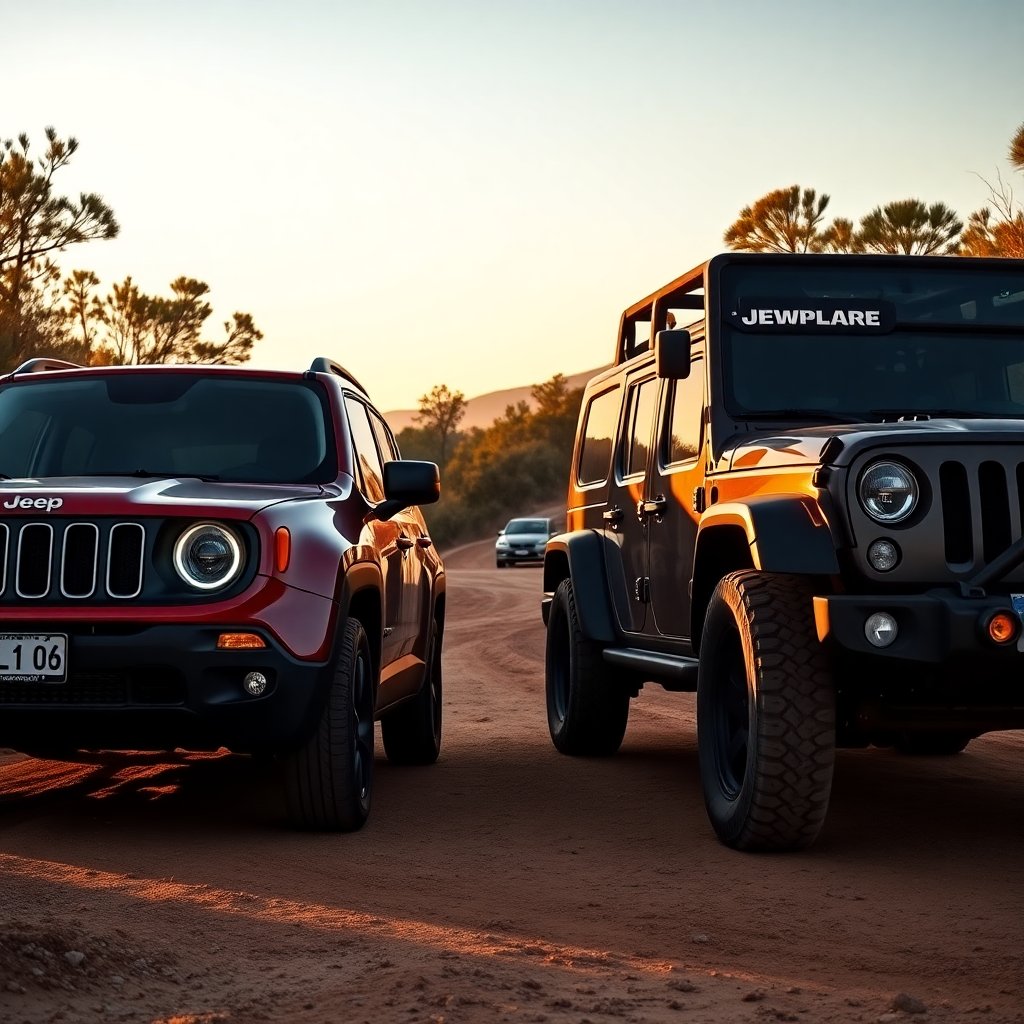
Both carry the Jeep name and both come with a Trailhawk trim. But the Renegade and Wrangler are fundamentally different vehicles built for fundamentally different customers. The confusion is understandable — the marketing doesn't help.
Here's the honest comparison for 2026 buyers.
What Each Vehicle Actually Is
The Wrangler is a purpose-built off-road vehicle that's been adapted for street use. Its solid front axle, removable doors and roof, and extreme approach/departure angles make it genuinely capable in situations that stop other vehicles cold. It exists for off-road use first.
The Renegade is a crossover SUV with decent off-road features added. The Trailhawk version has upgraded suspension, skid plates, and off-road tires, making it legitimately capable for light-to-moderate trails. But it's street car first, trail vehicle second.
This isn't a criticism of the Renegade — it's simply accurate positioning. The question is which one matches what you actually need.
Off-Road Capability: Head to Head
Ground Clearance
- Wrangler JL Sport: 10.8" (stock; more with a lift)
- Renegade Trailhawk: 8.7"
The Wrangler wins here meaningfully. Two extra inches of ground clearance isn't a small gap — it's the difference between clearing a rock and high-centering on it.
Approach / Departure / Breakover Angles
- Wrangler JL Sport: 44° / 37° / 27°
- Renegade Trailhawk: 30.1° / 34.4° / 22.2°
The Wrangler's angles are dramatically better. What this means in practice: the Wrangler can climb obstacles and descend slopes that will high-center the Renegade immediately. The 14° approach angle difference is enormous on technical terrain.
4WD System
- Wrangler: Selectable 4H/4L with a true low-range transfer case (4.0:1 crawl ratio)
- Renegade Trailhawk: Active all-wheel drive with a "Rock" terrain mode — no true low-range transfer case
The Wrangler's 4L is essential for slow, precise rock crawling. The Renegade's system works well for slippery roads and light off-road but has no equivalent capability for technical terrain requiring slow, controlled wheel speed.
Solid Axle vs. Independent Front Suspension
The Wrangler runs solid axles front and rear. The Renegade runs independent front suspension.
Solid axles flex more and maintain better contact in extreme articulation situations. On rocky terrain with significant wheel travel demands, this is a significant capability difference. For everything else — which is most driving — IFS offers a smoother on-road ride.
Tire Sizes
- Wrangler (stock): 255/70R18 on Sport S, up to 285/45R22 on Rubicon 392
- Renegade Trailhawk: 215/65R17 all-terrain
The Wrangler accepts significantly larger tires with modest lift work, further extending its capability advantage. The Renegade's smaller footprint limits tire upgrade options.
Wrangler vs. Renegade Comparison Table
| Spec | Wrangler JL Sport | Renegade Trailhawk | |---|---|---| | Ground clearance | 10.8" | 8.7" | | Approach angle | 44° | 30.1° | | Departure angle | 37° | 34.4° | | 4WD system | 4H/4L true low-range | Active AWD only | | Front axle | Solid | Independent | | Max tow | 2,000 lbs | 2,000 lbs | | Base MSRP (2026) | ~$32,000 | ~$28,000 | | Combined MPG | 22–24 | 25–28 | | Aftermarket support | Enormous | Limited |
Where the Renegade Wins
Daily Drivability
The Renegade is simply nicer to drive daily. Quieter, more comfortable, significantly better fuel economy (25–28 MPG vs. Wrangler's 22–24 MPG), and it doesn't attract the attention and minor security concerns that come with a convertible Wrangler in an urban setting.
Price and Ownership Cost
Renegades cost less new, depreciate more predictably, and cost less to maintain. The Wrangler's off-road components require more attention with heavy use. Insurance is typically lower on the Renegade.
Parking and Maneuverability
A Wrangler is a large vehicle with limited rear visibility, especially with the top up. In cities and tight parking situations, the Renegade's smaller footprint is a genuine practical advantage.
Ride Quality
The Wrangler's solid axles and stiff springs produce a noticeably rougher on-road ride than the Renegade's car-based independent suspension. Occupants who don't regularly go off-road will notice and prefer the Renegade's comfort.
The Right Answer for Each Buyer
Buy the Wrangler if:
- You plan to seriously off-road on technical trails
- Rock crawling or mud runs are in your future
- You want to lift it, put bigger tires on it, and build it out over time
- The weekend trail experience is a priority over daily comfort
- You want removable doors and roof for open-air driving
Buy the Renegade if:
- You want a capable daily driver with light trail capability
- Your off-road use is dirt roads, forest service roads, and moderate Trailhawk trails
- You're budget-conscious and want lower running costs
- You prioritize on-road comfort and practicality
- You rarely or never go on serious technical terrain
Modifying Each
The Wrangler has the richest aftermarket support of any 4WD vehicle in the world. Every conceivable accessory, in every price range, for every build type, is available and proven. Lift kits, bumpers, lockers, sliders, lighting, tops — the choices are genuinely endless.
The Renegade aftermarket is much smaller. Basic mods — skid plates, light bars, roof racks — are available, but the ecosystem doesn't come close to Wrangler support. If you want to build a rig over time, the Wrangler's aftermarket advantage is significant.
For trail-ready accessories on a Wrangler build, see our best Jeep Wrangler accessories guide for the priority build order.
A Note on Jeep Ducking
Since this is a Jeep community discussion: the Jeep ducking tradition (placing rubber ducks on other Jeep owners' door handles as a friendly gesture) is primarily a Wrangler thing. The tight-knit culture built around wave, duck, and trail brotherhood is something Renegade owners participate in to a degree — but it's unmistakably stronger in the Wrangler community.
If being part of that culture matters to you, that's a non-trivial factor worth acknowledging.
FAQ: Renegade vs. Wrangler
Can the Renegade Trailhawk keep up with a stock Wrangler on easy trails? On easy trails — graded dirt roads, forest service roads, moderate rocky paths — yes. The Trailhawk's 8.7" clearance and terrain modes handle everything a casual trail user needs. It's only on technical terrain (rated 4+ trails, rock crawling, significant articulation) where the Wrangler's capability becomes decisive.
Is the Wrangler's fuel economy really that much worse? In daily driving, yes. A JL Wrangler gets 22–24 MPG combined. The Renegade Trailhawk gets 25–28 MPG. At $3.50/gallon and 15,000 miles/year, the fuel cost difference is roughly $300–$400/year. Not negligible, but not decisive for most buyers.
Does the Wrangler make a good daily driver? Yes, with caveats. The JL Wrangler is significantly more refined as a daily driver than older JK models. It's comfortable on highways, capable in traffic, and no more inconvenient than other full-size SUVs. The main daily driver complaints are noise at highway speed (especially with aggressive tires) and fuel economy.
What's the best Renegade trim for someone who wants trail capability? The Trailhawk is the only Renegade worth considering for off-road use. It adds the genuine 4x4 AWD system, Selec-Terrain modes including Rock mode, hill descent control, skid plates, and all-terrain tires. The other trims are front-wheel-drive-based crossovers that happen to look like the Trailhawk.
Is the Wrangler safer than the Renegade? This is nuanced. The Renegade scores better in standardized crash tests (its independent suspension and lower center of gravity help). The Wrangler has a higher rollover risk on-road due to its taller stance but its structural rigidity and roll cage are legendarily strong. For crash avoidance and normal collision scenarios, the Renegade is the safer daily driver.
Bottom Line
The Wrangler is more capable, more modifiable, and more fun off-road. The Renegade is more practical, more comfortable daily, and costs less. They're not really competitors — they serve different needs.
If you're reading Trail Mods and thinking seriously about building a rig, the Wrangler is almost certainly what you want. If you want one vehicle that does everything adequately including light trails, the Renegade Trailhawk is a genuinely solid choice that won't embarrass you on the kind of trails most buyers actually encounter.
Know what you're buying for. Both are good at what they're designed to do.
As an Amazon Associate we earn from qualifying purchases. This article contains affiliate links; if you buy through them we may earn a small commission at no additional cost to you.