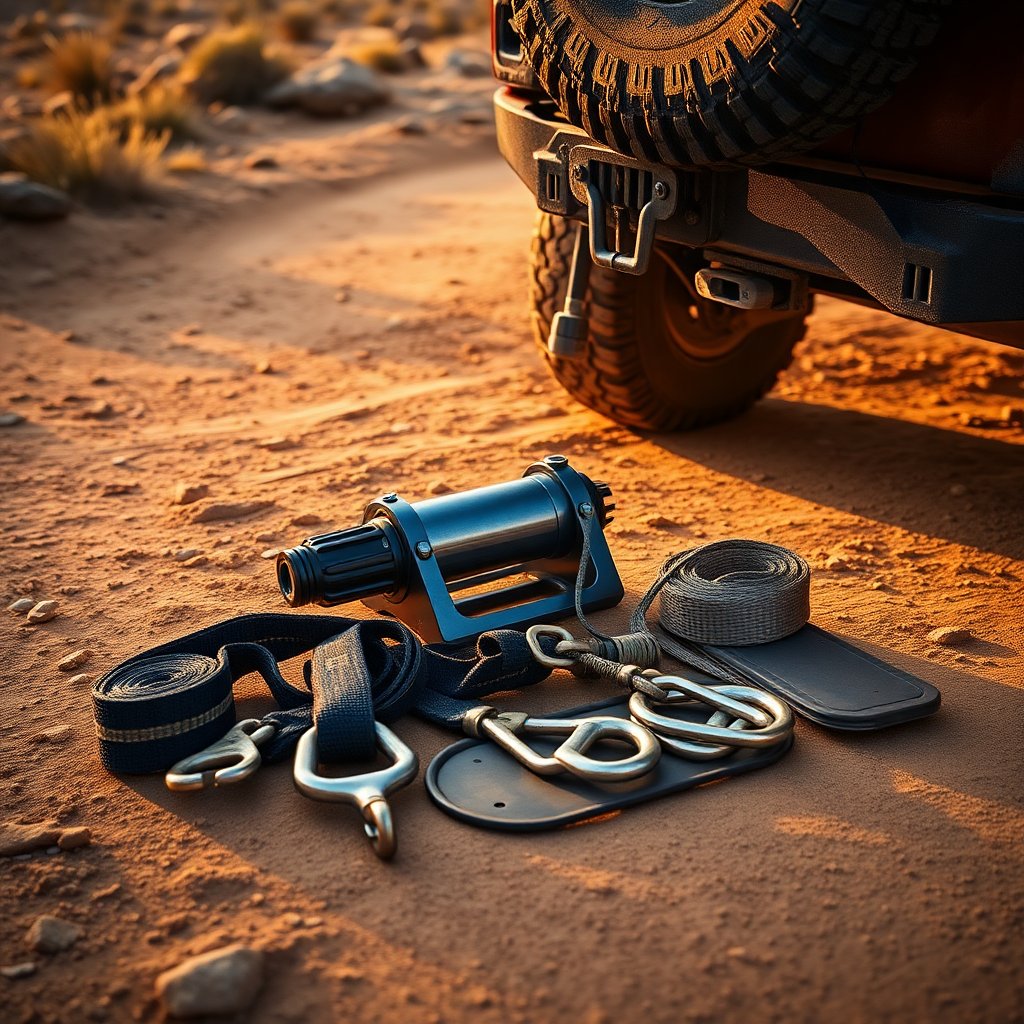
Every Jeep owner who has wheeled for more than a season has gotten stuck. It's not a matter of skill — it's just physics. The terrain wins sometimes. What separates a good day from a bad one is what you have with you when it does.
This is the recovery gear we actually carry and use. Not the stuff that looks good in gear reviews — the stuff that gets rigs unstuck.
The Minimum Kit
Before you hit any serious trail, your Jeep should have:
- Kinetic recovery rope (not a static tow strap)
- Two bow shackles / D-rings rated at 3/4" or larger
- Hi-lift jack
- Portable air compressor
- Gloves (recovery gear will shred bare hands)
That's the floor. If you only have one of these, get the kinetic rope and shackles first. For a broader look at what to prioritize before you hit the trail, see our full guide to the best Jeep Wrangler accessories.
Kinetic Rope vs. Static Strap
Most people start with a tow strap. This is a mistake.
A static strap has no stretch. When you jerk a buried rig with a static strap at the right speed, one of three things happens: the strap snaps (dangerous), the recovery point rips off the vehicle (expensive), or the pulling vehicle breaks its drivetrain (catastrophic).
A kinetic recovery rope stretches 20–30% under load and stores energy like a bungee cord. The yanking vehicle builds momentum, the rope stretches, and that stored energy releases to pull the buried rig free. It's dramatically more effective and far less likely to cause damage.
The Bubba Rope brand is the community standard. The 3/4" 20' version handles the vast majority of recovery situations for a Wrangler-sized rig.
→ Shop Bubba Rope kinetic recovery ropes on Amazon
Note on shackles: Never use bolt shackles for kinetic recovery. Bow (D-ring) shackles only. The bow shackle absorbs the lateral load from a kinetic pull; bolt shackles are designed for static loads and can fail explosively under kinetic load. Use rated 3/4" bow shackles (ARB, Smittybilt, or Warn) and replace them if they've taken significant impacts.
The Hi-Lift Jack
The Hi-Lift is the most versatile recovery tool on your rig. It doesn't just lift — it can:
- Lift the vehicle to remove a tire from a hole or rock
- Clamp and pull using the Handle-All jack accessory
- Push and spread components
- Work as a come-along for winching applications without a winch
Get the 48" all-cast Hi-Lift jack. The 36" doesn't clear the height on lifted Jeeps and the all-cast construction is more durable than the painted version for long-term use.
Always mount it accessibly — on a bumper mount or roll bar bracket, not buried under gear. A hi-lift you can't reach in 60 seconds is less useful in a real emergency.
Hi-Lift safety note: The Hi-Lift is a powerful tool with serious pinch hazards. Never put any body part under a vehicle supported only by a Hi-Lift. Always use it as intended, with both hands engaged. The Handle-All accessory makes clamping operations safer.
MAXTRAX Recovery Boards
MAXTRAX boards are Australian-engineered plastic recovery devices you slide under your tires when high-centered or stuck in soft terrain. The aggressive tread pattern grabs your tire and provides a stable surface to drive out on.
They work when nothing else does — particularly in sand, snow, and loose mud. The MKII version is more durable than the originals and justifies the price increase.
The knockoffs are not equivalent. Several Chinese-made alternatives exist at half the price, but the plastic compounds are softer and the tread patterns don't grip the same way. Buy MAXTRAX once.
→ Shop MAXTRAX recovery boards on Amazon
How to use them: Place boards under the tires that are slipping (usually the rear). Pack snow, mud, or sand around the edges to keep them from moving. Drive forward slowly — don't spin the tires hard. The boards float out once the vehicle is free; retrieve them immediately before the next vehicle drives over them.
Air Compressor
Airing down to 15–18 PSI is one of the most effective off-road techniques available to any wheeled vehicle. Lower pressure dramatically increases the tire's footprint, improving traction on rock, sand, and mud.
The problem: you need to air back up before driving on pavement, or you'll destroy the tires. A quality 12V compressor that can inflate a 35" tire in 4–5 minutes is essential.
VIAIR 400P is the gold standard. It's weatherproof, has a proper duty cycle rating, and will be in your rig for 10 years.
→ Shop VIAIR 400P portable air compressor on Amazon
Avoid cheap Amazon compressors under $50. They overheat on the second tire and fail within a season.
How far to air down: For sand, 12–15 PSI. For rock, 18–22 PSI depending on tire size and weight. For mud, 15–18 PSI. Always re-inflate to highway pressure before leaving the trail.
Advanced Recovery: Winches and Snatch Blocks
A winch is the ultimate self-recovery tool — but it only works when there's something to anchor to. A snatch block doubles your winch's pulling power and changes the angle of pull, letting you recover in situations where there's no direct anchor point.
If you run a winch, always carry:
- Snatch block rated above your winch's pull capacity
- Tree saver strap (synthetic, not chain, to protect anchor trees and your snatch block)
- Deadman anchor for soft ground where there are no trees
Winch sizing: For a JL Wrangler or JT Gladiator, an 8,000–10,000 lb winch handles all standard recovery situations. The Warn Zeon 10-S, Warn VR10, and Smittybilt X2o 10K are community-tested options in this range.
Recovery Gear Comparison Table
| Item | Essential? | Cost Range | Recommended Brand | |---|---|---|---| | Kinetic recovery rope | Yes | $60–$150 | Bubba Rope, ARB | | D-ring bow shackles (×2) | Yes | $20–$50 pair | ARB, Warn, Smittybilt | | Hi-Lift jack (48") | Yes | $80–$150 | Hi-Lift Brand | | Air compressor | Yes | $100–$250 | VIAIR 400P | | Recovery boards (MAXTRAX) | Highly recommended | $200–$300 | MAXTRAX MKII | | Snatch block | If winching | $30–$80 | Warn, ARB | | Tree saver strap | If winching | $30–$60 | ARB, Bubba Rope | | Winch (8,000–10,000 lb) | Advanced | $400–$900 | Warn, Smittybilt |
Recovery Ethics and Trail Protocol
Never wheel alone. The safest recovery situation is one where a second vehicle is there to help. If you must go solo, carry more recovery gear and be more conservative with terrain choices.
Tell someone where you're going. Before any serious trail run, text your destination, planned trail, and expected return time to someone not on the trip.
Leave the campsite better than you found it. Don't cut trees for anchors. Use a tree saver when anchoring to anything living. Leave nothing behind.
Know your recovery points. Factory recovery hooks on most Wranglers are adequate for straight pulls. For kinetic recovery, purpose-built receiver-hitch recovery points (rated for snatch loads) are safer. The ARB recovery hitch receiver is the community standard.
Trail-Ready Recovery Setup by Budget
Under $200: Kinetic rope + shackles + hi-lift jack — the minimum for responsible trail use
Under $400: Add MAXTRAX boards — transforms your soft-terrain capability
Under $600: Add VIAIR 400P compressor — complete recovery capability for most situations
$600+: Add a quality winch — self-rescue capability in situations where no second vehicle is available
FAQ: Off-Road Recovery Gear
Do I need recovery gear if I'm just doing easy trails? Yes. Easy trails can still swallow a Jeep. A kinetic rope and shackles cost $80–$120 and fit in a small bag. There's no situation where having them is worse than not having them.
How do I carry a hi-lift jack safely? Mount it on your rear bumper, tire carrier, or a dedicated roll bar mount — never loose in the cargo area. A loose hi-lift bounces violently in a crash or even on rough terrain. Several manufacturers make specific mount systems for each Jeep platform.
Can I use my factory tow hooks for kinetic recovery? The factory hooks on most JL/JK models are rated for towing, not snatch recovery. The dynamic loads in a kinetic pull can exceed the ratings of factory hooks. Purpose-built recovery points from Smittybilt, ARB, or Warn rated for snatch loads are safer. If using factory points, be conservative with pull speed.
What's the most common reason Jeeps get stuck? Overconfidence and under-preparation. Drivers who assume a trail is within their capabilities without a recovery plan are the most common rescue calls. Know your terrain rating, know your vehicle's limits, and have your recovery gear sorted before you need it.
How do I learn proper recovery technique? Take an off-road recovery course. Many 4WD clubs run annual training days. The Jeep Jamboree events include recovery training. First Aid for recovery situations is also worth learning — gear without technique has limits.
Final Thoughts
Recovery gear is insurance. You buy it hoping you'll never need it, but you bring it every time. The cost of a complete kit — rope, shackles, hi-lift, compressor, boards — is under $600 and it's a one-time purchase that lasts years.
Getting stuck on a trail with a prepared rig is an adventure. Getting stuck without recovery gear is a crisis. The difference is $600 and 15 minutes of setup.
As an Amazon Associate, we earn from qualifying purchases at no additional cost to you.
As an Amazon Associate we earn from qualifying purchases. This article contains affiliate links; if you buy through them we may earn a small commission at no additional cost to you.