You've aired down for a technical section, cleared the obstacle, and now you're staring at four 15 PSI tires that need to go back to 35 PSI before you hit pavement. With a cheap gas station pump, you're looking at 45 minutes of standing around. With the right compressor setup, you're back on the road in under 10 minutes. The difference between portable and onboard systems comes down to how you use your rig, what you're willing to mount, and whether you need air for more than just tires.
Why Air Systems Matter for Trail Rigs
Airing down improves traction, reduces impact harshness, and protects your drivetrain on rocky terrain. Most overlanders run 12-18 PSI on trails compared to 32-38 PSI on highway. That pressure reduction increases your tire's contact patch by 20-30%, which matters when you're crawling over boulders or navigating loose sand. But dropping pressure means you need a reliable way to inflate again—and a functional air compressor is as essential as recovery gear for any serious trail rig.
Beyond tires, onboard air powers ARB air lockers, inflates camping gear, runs air tools, and powers train horns (if that's your thing). The compressor you choose determines how quickly you can air up four 35-inch tires and whether you have enough flow rate for multiple tasks. CFM (cubic feet per minute) ratings tell you actual performance—most trail compressors range from 1.5 CFM to 6.5 CFM at 100 PSI, and that difference is the gap between a 6-minute inflation and a 25-minute ordeal.
Portable Air Compressors: Flexibility and Simplicity
Portable compressors plug into your 12V outlet or battery terminals, sit in your cargo area, and move between vehicles. They cost $80-$400 depending on flow rate and duty cycle. Entry-level units like the $100-$150 models push 1.5-2.0 CFM, which handles 33-inch tires but struggles with anything larger. Mid-range portables hit 2.5-3.5 CFM and include thermal protection to prevent overheating during extended use.
The real advantage is mounting flexibility. You can store a → Shop portable tire inflator off-road on Amazon in a bed box, throw it in a friend's truck, or use it on your daily driver. No permanent mounting hardware means you're not drilling holes or routing wiring through your firewall. For weekend warriors who run mild trails and don't need air lockers, portables eliminate installation complexity while delivering adequate performance.
The downside is duty cycle. Most portables max out at 25-30% duty cycles—run for 15 minutes, cool for 45 minutes. Airing up four 35-inch tires from 15 PSI to 35 PSI requires about 20 minutes of compressor runtime with a 2.5 CFM unit. Factor in cooling breaks, and you're looking at 30-40 minutes total. Cheaper models lack thermal cutoff switches and will overheat if you push them, which means replacing the compressor entirely rather than just waiting for it to cool.
Onboard Air Compressor Systems: Power and Integration
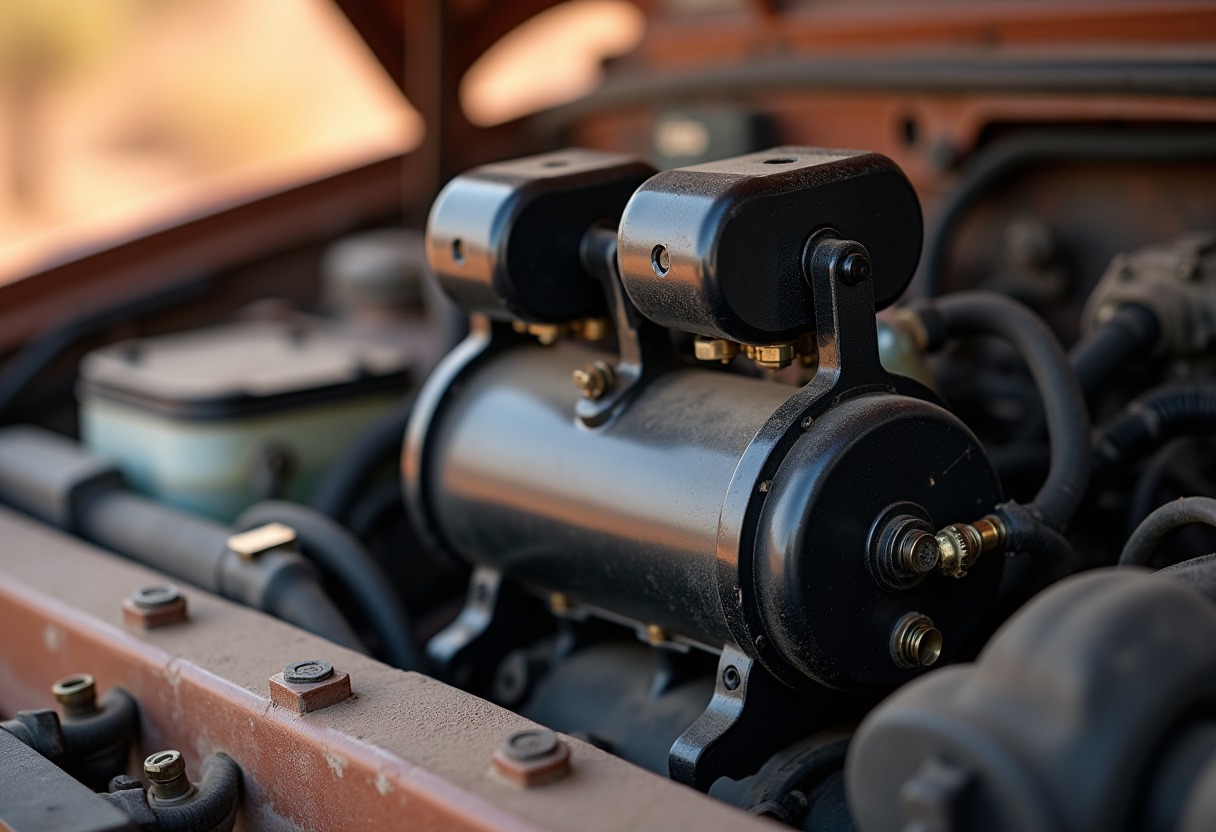
Onboard systems mount permanently under your hood, in your bed, or beneath your chassis. They wire directly to your battery through a relay, often with dash-mounted switches and pressure gauges. CFM ratings range from 2.5 CFM (basic ARB single) to 6.5 CFM (VIAIR 450C dual setup), and duty cycles hit 33-100% depending on the model. ARB and VIAIR dominate this space—both companies build compressors specifically for continuous off-road use.
The ARB CKMA12 Twin pushes 6.16 CFM at zero PSI and maintains solid flow at working pressure. It mounts under the hood on most Wranglers, 4Runners, and Broncos using vehicle-specific → Shop air compressor mount bracket on Amazon kits. Wiring runs through your firewall to a dash switch and directly to your battery with a 40-amp circuit breaker. Installation takes 3-4 hours if you're comfortable with basic wiring and drilling mounting holes. You'll need to tap into your frame or find existing bolt points, route air lines to a manifold (usually mounted on your bumper or rock sliders), and test for leaks.
VIAIR's 450C and 480C models offer similar CFM with slightly different form factors—the 450C fits tighter spaces, while the 480C delivers marginally higher flow. Both handle 100% duty cycles, meaning they can run continuously without thermal shutdown. That matters when you're inflating four 37-inch tires or running air tools on the trail. The 480C pulls about 30 amps at full load, so you'll want to verify your alternator can handle it alongside your lighting setup and winch.
Portable vs. Onboard: Direct Comparison
| Feature | Portable Compressor | Onboard Compressor | |---------|---------------------|-------------------| | CFM Output | 1.5-3.5 CFM | 2.5-6.5 CFM | | Duty Cycle | 15-30% (cooling breaks required) | 33-100% (continuous operation) | | Installation | Plug-and-play, no mounting | 3-4 hour install, permanent mounting | | Cost | $80-$400 | $300-$900 (plus install materials) | | Tire Inflation Time | 25-40 minutes (four 35" tires) | 8-15 minutes (four 35" tires) | | Air Locker Support | Limited (low flow, duty cycle) | Full support (sustained pressure) | | Storage | Cargo area (takes space) | Mounted (frees cargo space) |
Onboard systems also integrate with air tanks—2.5 to 5-gallon tanks store compressed air at 150-200 PSI, which lets you air up one tire instantly or run air tools without waiting for the compressor to catch up. Most serious overlanders run a tank with their onboard system, mounting it under the bed or behind the rear seat. ARB sells manifold kits that include pressure regulators, gauges, and quick-disconnect fittings for multiple outputs.
Specific Product Recommendations
For portable use on 33-35" tires, the Smittybilt 2781 hits 2.54 CFM with a 25% duty cycle. It includes a pressure gauge, 8-foot hose, and carrying bag. Price sits around $150, which balances performance against cost for occasional trail use. It'll handle Best Jeep Wrangler Mods without requiring permanent installation.
For mid-duty portable power, the → Shop VIAIR compressor on Amazon 88P delivers 1.47 CFM with better heat management than cheaper units. It's the go-to for Tacoma and 4Runner owners who want reliability without mounting hardware. Expect 30-35 minutes for four 35" tires.
For onboard installation on Wranglers and Gladiators, the ARB CKMA12 Twin pairs with ARB's Jeep-specific mounting brackets and integrates cleanly with Best Jeep Gladiator Accessories setups. It'll support dual air lockers while still inflating tires in under 10 minutes. → Shop ARB air compressor on Amazon.
For maximum CFM in onboard systems, the VIAIR 480C pushes 2.32 CFM at 100 PSI with 100% duty cycle. Mount it under your hood or bed, add a 2.5-gallon tank, and you've got instant air for tools and fast tire inflation. Works across platforms—Broncos, 4Runners, Tacomas. According to Motor Trend's off-road testing data, dual VIAIR setups cut inflation times in half compared to single-compressor systems.
For budget onboard, the VIAIR 400P hits 2.30 CFM at 33% duty cycle for around $300. It's not as robust as the 480C but handles occasional trail use and supports a single air locker. Mount it in your bed or spare tire area if under-hood space is tight.
Advanced Installation and System Integration
Running air lines from your compressor to usable outputs requires planning. Most builders install a manifold near their rear bumper or rock sliders with at least two quick-disconnect fittings—one for tire inflation, one for accessories. Use DOT-approved air brake line (1/4" or 3/8" diameter) rated for at least 200 PSI. Route lines away from exhaust, sharp edges, and moving suspension components. Secure with P-clamps every 12-18 inches.
Air tank sizing depends on your use case. A 2.5-gallon tank stores enough air to inflate one 35-inch tire from 15 to 35 PSI without the compressor running. Larger 5-gallon tanks give you two tires or extended air tool runtime. Mount tanks horizontally in your bed or vertically behind your rear seat, and always install a drain valve at the lowest point to purge moisture.
Pressure switches automate your system—they cut the compressor once the tank hits 150 PSI and restart when pressure drops below 120 PSI. Wire them into your relay circuit so the compressor only runs when you flip the dash switch AND pressure is low. This protects the compressor from constant cycling and extends its lifespan. ARB and VIAIR both sell pressure switch kits designed for their compressors.
For rigs with air lockers, run a dedicated line from your tank to the locker solenoid. Most lockers need 90-120 PSI to engage, and a tank ensures instant lock-up even if your compressor is off. If you're running front and rear lockers, you'll need separate solenoids for each axle. This is standard on serious Best Jeep Wrangler Mods builds and overlanding setups.
FAQ
How long does it take to air up four 35-inch tires from trail pressure?
With a 2.5 CFM portable, expect 30-40 minutes including cooling breaks. A 6.0 CFM onboard system cuts that to 8-12 minutes. Tire size and starting pressure change the math—37-inch tires add roughly 30% more time.
Can I power a portable compressor from my cigarette lighter outlet?
Only low-CFM models under 2.0 CFM work reliably from 12V outlets, which are typically fused at 10-15 amps. Higher-output compressors need direct battery connection with alligator clamps to pull 20-30 amps safely.
Do I need an air tank with an onboard compressor?
Not required, but a 2.5-gallon tank dramatically improves system response for air lockers and lets you inflate one tire instantly. For air tools or extended use, tanks prevent the compressor from running continuously.
What's the real difference between ARB and VIAIR compressors?
ARB units typically offer higher CFM in twin-cylinder configs and integrate cleanly with ARB lockers. VIAIR focuses on single-piston designs with better thermal management and 100% duty cycles. Both are field-proven—choose based on CFM needs and mounting space.
How much does professional installation cost for an onboard system?
Shops charge $200-$400 for labor depending on mounting complexity and whether you're adding a tank and manifold. DIY saves money but requires basic wiring skills and 3-4 hours. Best Jeep Wrangler Accessories 2026 builds often include compressor installs as part of larger fab work.
The Bottom Line on Air Systems
Choose portable if you're running 33-inch tires on weekend trips and want plug-and-play simplicity. Choose onboard if you've already committed to armor, lift kits, and serious trail use—because once you've experienced 8-minute tire inflation and instant air locker response, you won't go back to cooling breaks and 30-minute inflations.
Some links on this page are affiliate links. We may earn a small commission if you purchase through them, at no extra cost to you.
As an Amazon Associate we earn from qualifying purchases. This article contains affiliate links; if you buy through them we may earn a small commission at no additional cost to you.