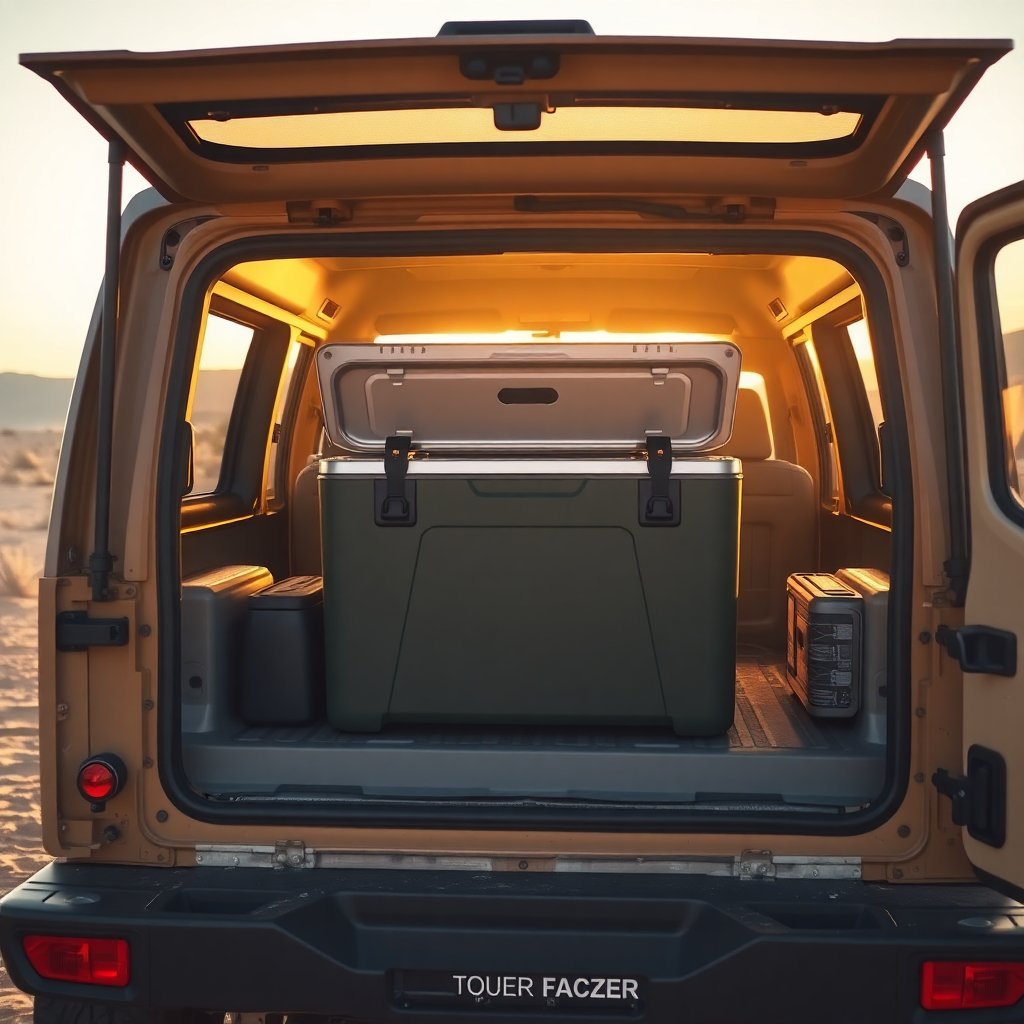
Cold food on a multi-day trip used to mean a cooler, a bag of ice, and a soggy mess by day two. A 12V compressor fridge changes that math entirely. It keeps meat frozen and drinks cold on the worst washboard road, runs straight off your truck's electrical system, and never once asks you to detour for a bag of ice. For most overlanders building out a rig this fall, the fridge is the single upgrade that most improves daily camp life.
This guide covers how compressor fridges actually work, how to size one for your trips, what the real power draw looks like, how to mount it so it survives corrugations, and which configurations are worth buying. The goal is to get you to a confident purchase without overspending on capacity or features you will not use.
Affiliate disclosure: some links below are Amazon affiliate links. If you buy through them, this site may earn a small commission at no extra cost to you.
Why a compressor fridge beats a cooler and a thermoelectric box
There are three ways to keep food cold in a vehicle, and only one of them is worth your money. A traditional cooler just slows down melting ice, so you are managing a countdown clock and draining meltwater every morning. Thermoelectric (Peltier) boxes plug into a 12V socket but can only pull the temperature down roughly 30 to 40 degrees below ambient, which means on a 95-degree desert afternoon your "fridge" is sitting at 60 degrees. That is not safe for raw meat and not satisfying for a cold drink.
A compressor fridge uses the same vapor-compression cycle as the refrigerator in your kitchen, just shrunk down and running on DC power. It can hold a true 35 degrees for the fridge or well below freezing regardless of how hot it is outside. Most modern units use a variable-speed Danfoss/Secop-style compressor that ramps down once the box is cold, which is what makes the power draw manageable. Expedition Portal's long-running field testing of portable fridges is a good reality check on how these units perform over months of real trail use rather than a single weekend.
The short version: if you are camping more than one night, skip the ice. A compressor fridge pays for itself in convenience within a season.
Single zone vs dual zone
The biggest fork in the decision tree is whether you want one temperature zone or two.
Single zone fridges have one compartment set to one temperature. You pick fridge or freezer, not both at once. These are simpler, cheaper, lighter, and draw slightly less power. For solo travelers and couples who mostly want cold food and drinks, a single zone is often the smarter buy.
Dual zone fridges split the box into two compartments with independent temperature control, so you can run the left side as a freezer at 0 degrees and the right side as a fridge at 38 degrees simultaneously. This is the move for longer expeditions, families, or anyone who wants ice cream at camp and frozen meat that thaws as the trip goes on. The tradeoff is more money, more weight, and slightly higher total draw.
A practical middle path exists on many single-zone units: run the whole box at fridge temperature most of the trip, then drop it to freezer for the first 48 hours when your pre-frozen meat is doing the heavy lifting. Browse 12V dual zone fridge options on Amazon if you know you need both, or stick with a single zone to save weight and cash.
Sizing: how many liters do you actually need
Capacity is quoted in liters, and overlanders consistently buy too big. A larger fridge costs more, weighs more, takes up cargo space you will miss, and draws more power. Use trip length and head count to size it:
- Weekend solo or couple: 30 to 45 liters is plenty. You can fit a couple days of food and a dozen drinks without the box swallowing your whole cargo area.
- Four to seven day trips, two people: 45 to 55 liters. Enough for fresh produce, proteins, and a freezer stash without resupply.
- Family of four or week-plus expeditions: 60 to 75 liters, ideally dual zone. Beyond that you are usually better off adding a second small fridge than buying one enormous box that you cannot lift when loaded.
Remember that quoted capacity includes space you cannot really use once you account for the compressor hump and the need to not pack it wall to wall. Treat the number as roughly 15 percent optimistic. When you are ready to compare real-world sizes, this overlanding fridge/freezer search lets you filter by capacity and price in one place.
Power draw and keeping your battery alive
This is the part that scares people, and it should not. A quality compressor fridge is remarkably efficient once the box is cold. A typical 50-liter unit holding 38 degrees in warm weather averages somewhere around 0.7 to 1.0 amp-hours per hour over a full day, because the compressor cycles off most of the time. Over 24 hours that is often in the 20 to 40 amp-hour range depending on ambient heat and how often you open the lid.
The real enemy is not the fridge, it is running it off your starting battery overnight with the engine off. Do not do that. You have three sane options:
A dedicated house battery. A second battery, ideally lithium, isolated from your starter battery with a DC-DC charger that tops it off while you drive. This is the gold standard for anyone running a fridge regularly. It also powers lights, a Starlink dish, and device charging without threatening your ability to start the truck in the morning. If you have not sorted your electrical system yet, our guide to overland power and jump starters covers the backup side of the equation.
A portable power station. A lithium "solar generator" you recharge while driving or from a panel. Less permanent, no wiring, and it doubles as a household backup at home. For many overlanders this is the easiest entry point. Here is a portable power station search sized for a fridge.
Solar top-up. A folding panel keeps the house battery or power station from slowly draining on multi-day stationary camps. It is a supplement, not usually a standalone solution, but on a sunny desert trip a 100-watt panel can nearly offset a fridge's daily draw.
Pair any of these with a battery monitor so you actually know your state of charge instead of guessing. The same electrical planning that supports a fridge is what makes a connected camp possible, which is why it overlaps so heavily with our Starlink Mini overlanding setup.
Mounting so it survives the trail
A fridge that slides around the cargo area will trash itself and your gear on corrugations. Two things matter here.
A fridge slide is a rail-mounted tray that lets you pull the fridge out past the tailgate for access, then lock it in place for travel. It is the difference between crawling over the tailgate to reach the bottom of the box and simply sliding it out at camp. Many slides also tilt, which helps on uneven ground. A good fridge slide mount is one of those accessories you only buy once if you buy the sturdy one.
Tie-down points matter even with a slide. The compressor is on a floating mount inside the fridge and can tolerate some angle, but the box itself needs to be strapped so it cannot become a projectile in a rollover or hard stop. Most quality fridges include mounting feet or lugs for exactly this.
One more small upgrade worth the money: an insulated fridge cover. It reduces how hard the compressor works in direct sun, cuts your daily amp-hour draw, and protects the finish. On hot trips the efficiency gain alone can be meaningful.
Features that are worth it and features that are not
Worth paying for: a variable-speed compressor, a sturdy latching lid with a gasket that seals, interior LED lighting, a drain plug for cleaning, and low-voltage cutoff protection that shuts the fridge down before it kills your battery. App-based temperature control via Bluetooth is genuinely useful for checking the box from inside the tent on a cold morning.
Nice but not essential: USB ports built into the fridge, ice-maker compartments, and premium brand badging. These add cost without changing whether your food stays cold.
Skip: anything marketed as a "12V cooler" without the word compressor, and any thermoelectric unit sold as a fridge. They cannot hold safe temperatures in real heat.
For food safety, keep the fridge compartment at or below 40 degrees for perishables and your freezer at or below 0 degrees, and let pre-frozen food do the cooling work for the first day or two to ease the compressor in.
Recommended configurations by trip style
The minimalist solo setup: a 30 to 40 liter single zone fridge, a mid-size portable power station, and a folding solar panel. No permanent wiring, easy to move between vehicles, and more than enough for weekend trips.
The dialed weekend-warrior rig: a 45 to 55 liter single zone fridge on a locking slide, fed by a second battery with a DC-DC charger. This is the sweet spot for most couples and covers four to seven day trips comfortably.
The expedition family build: a 60 to 75 liter dual zone fridge, a lithium house battery bank, solar on the roof, and a tilt slide for access. More weight and cost, but it carries real groceries for a week-plus without resupply.
Whatever tier you land in, buy the fridge once and buy it right. A quality compressor unit will outlast several vehicles, and it is the camp upgrade you will notice every single evening on the trail.
Match the fridge to how you actually travel, sort the power system that feeds it before the first trip, and strap it down properly. Do those three things and you will never look at a bag of ice the same way again.
As an Amazon Associate we earn from qualifying purchases. This article contains affiliate links; if you buy through them we may earn a small commission at no additional cost to you.