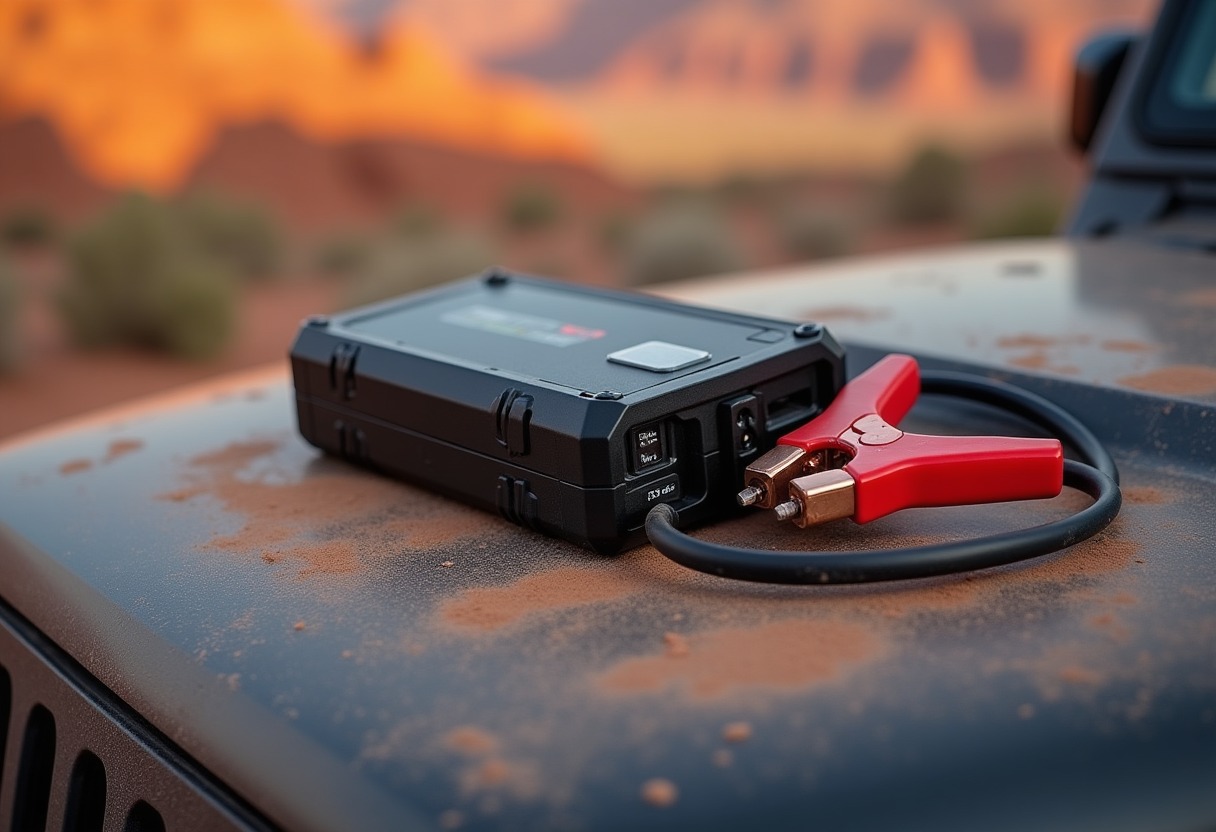
Your battery dies thirty miles into a remote trail, and the last vehicle you saw was two hours ago. A portable jump starter turns a potential multi-day extraction into a five-minute restart. The lithium packs now hitting the market deliver 1,000+ peak amps in packages smaller than a hardcover book, but capacity ratings lie, cold weather kills performance, and cheap units fail when you actually need them.
Why Lithium Jump Starters Beat Traditional Jumper Cables
Lead-acid jump boxes weigh 15-30 pounds and lose charge sitting in your rig. Lithium battery packs weigh 1-3 pounds, hold charge for 6-12 months, and deliver higher peak current. The chemistry matters: lithium iron phosphate cells maintain voltage under load better than older lithium-ion designs, which means more reliable starts on big-displacement engines.
Peak amp ratings sell units, but they're misleading. Manufacturers rate "peak amps" at the first millisecond of connection — a nearly useless metric. Cranking amps (CA) or cold cranking amps (CCA) measured at sustained draw tell you what the pack actually delivers when spinning a starter motor. A 2,000-peak-amp unit might only sustain 400-500 amps, which starts most gas engines but struggles with diesel compression.
Temperature kills capacity. Lithium cells lose 20-40% output below 32°F, and most compact packs don't include heating circuits. Research from Battery University shows lithium-ion cells can lose up to 50% capacity at 0°F. Keep your pack inside your cab or sleeping bag in winter, not strapped to an external rack where it'll freeze solid.
What Separates Trail-Ready Units from Consumer Models
Engine displacement determines minimum amperage. A 2.0L four-cylinder Jeep Wrangler starts reliably with 300 cranking amps. A 3.6L Pentastar V6 needs 400-500. Toyota's 3.5L V6 in the Tacoma and 4Runner pulls similar current. Diesel engines require 50-100% more amperage because of higher compression ratios — budget 600-800 amps minimum for a turbo diesel.
Battery type in your rig matters too. AGM batteries have lower internal resistance than flooded lead-acid, so they draw peak current faster but for shorter duration. If you run dual batteries or lithium house batteries, your jump starter needs enough reserve to cycle multiple start attempts without depleting.
Build quality separates overnight-dead units from reliable tools. Check for:
- IP65 or higher ingress protection — dust and water resistance for exposure in bed-mounted recovery bags
- All-metal clamps — plastic clamps melt under high current or crack in UV exposure
- Reverse polarity protection — prevents catastrophic shorts when you connect backward in the dark
- Thermal cutoff circuits — shuts down before overheating damages cells
Multi-function features add utility but also failure points. Built-in air compressors work for emergency tire inflation but add 2-4 pounds and complexity. USB outlets charge phones and run small 12V accessories, but cheap voltage converters introduce noise that damages electronics. LED flashlights get used more than you'd expect when jumping a battery at night — prioritize units with separate strobe and SOS modes.
Peak Amps vs Real-World Performance
| Unit Spec | Gas Engine Capacity | Diesel Engine Capacity | Winter Performance (0°F) | Weight | |-----------|---------------------|------------------------|--------------------------|--------| | 1,000 peak amps | Up to 3.0L | Up to 2.0L | Marginal below 20°F | 1-1.5 lbs | | 2,000 peak amps | Up to 4.0L | Up to 3.0L | Reliable to 10°F | 1.5-2.5 lbs | | 3,000 peak amps | Up to 6.0L | Up to 4.5L | Reliable to 0°F | 2.5-3.5 lbs | | 4,000+ peak amps | 7.0L+ / Multiple starts | 5.0L+ / Multiple starts | Reliable below 0°F | 4-6 lbs |
Those ratings assume fresh charges and batteries in reasonable condition. A sulfated battery with one dead cell pulls double the normal current and drains jump packs fast. If your rig's battery is three years old and you're heading into the backcountry, replace it before the trip rather than trusting a jump starter to compensate for a failing battery.
Tested Units That Actually Work
Compact single-engine starters (1,000-2,000 peak amps) fit in glove boxes and weigh under two pounds. These handle most gas engines and work as USB power banks for phones and GPS units. Look for 10,000+ mAh capacity to ensure multiple jump attempts. → Shop lithium jump starter on Amazon
Mid-capacity boosters (2,000-3,000 peak amps) are the sweet spot for overlanders running V6 gas engines or smaller diesels. They'll start a 3.6L Pentastar or 2.8L Duramax in moderate cold, deliver 4-6 jumps per charge, and include air compressors or work lights without excessive bulk. Models with 20,000+ mAh capacities double as expedition power banks. → Shop portable jump box on Amazon
Heavy-duty diesel packs (3,000-4,000 peak amps) target big-displacement engines and commercial equipment. These start 6.7L Power Strokes and Cummins blocks in single-digit temps, but they weigh 4-6 pounds and cost $200-400. Only necessary if you're running diesel or need to jump multiple vehicles on group runs. → Shop battery booster pack on Amazon
Combo units with compressors make sense for solo overlanders who value consolidation. A quality unit combines 2,000+ peak amps with a 120-150 PSI compressor capable of 30-40 LPM airflow. That's enough to air up 35" tires from 15 PSI to 30 PSI in 12-15 minutes per tire. Check compressor duty cycle — cheaper units overheat after 10 minutes and need 20-minute cooldowns. → Shop 12V jump starter portable on Amazon
Expedition power stations cross into different territory — 40,000+ mAh lithium packs with 12V, USB, and AC outlets. They'll jump-start engines but primarily function as camp power for fridges, lights, and laptops. Weight runs 8-15 pounds, so these stay in camp or rig-mounted storage. Pair with solar panels for multi-day power independence. → Shop off-road power bank on Amazon
Capacity degrades with charge cycles. Lithium packs rated for 500-1,000 cycles lose 10-20% capacity after 300 cycles in real-world use. If you jump-start weekly, expect replacement every 2-3 years. Monthly use extends life to 5-7 years. Store at 50-70% charge in temperature-controlled spaces, not at full charge in hot vehicles where accelerated degradation happens.
Integration with Recovery Gear and Vehicle Systems
Mount your jump starter where you can grab it fast. Door pockets work for compact units. Larger packs belong in recovery bags with snatch straps and gloves — everything you need for roadside stops in one grab. Some overlanders wire Anderson connectors to their winch battery as a backup jump point, using the jump pack to energize the winch battery rather than the starting battery.
USB charging matters more than manufacturers admit. Modern GPS units, satellite communicators, and trail cameras all run USB-C at 18W+ fast-charge rates. Older jump starters output 5V/2A maximum — barely adequate for phones, useless for tablets. Look for units with USB-C PD (Power Delivery) at 18-30W minimum if you're powering navigation gear.
Air compressor integration saves weight but demands quality. Built-in compressors should hit 120 PSI minimum and 30+ LPM airflow to be useful. Cheaper units max out at 100 PSI and 15 LPM — fine for car tires at 35 PSI, inadequate for airing up 35" truck tires from trail pressures. Screw-type compressors outlast piston designs and handle continuous duty better. For dedicated compressor needs, check the overland air compressor guide for standalone options.
Dual-battery systems in built rigs create jump-starting complications. If your starting battery dies but your house battery is charged, you need a way to isolate and jump across systems. Some overlanders carry a second smaller jump pack specifically for the house battery, letting them jump the starter from the house side without carrying heavy cables between batteries.
Cold-Weather Performance and Maintenance Reality
Lithium cells hate cold starts. Below 20°F, expect 30-50% capacity loss even on quality units. Below 0°F, cheap packs won't deliver rated current at all. Premium units include low-temperature disconnect circuits that prevent damage but also prevent jumping. The workaround: warm the pack against your body for 10 minutes before attempting a jump in sub-freezing temps.
Charge maintenance prevents failures. Lithium packs self-discharge 2-5% per month stored. Check charge every 60 days minimum, recharge if below 50%. Most units include trickle-charge circuits that prevent overcharge damage when left plugged in, but verify in the manual before leaving connected long-term.
Clamp maintenance matters. Copper clamps oxidize green in humid climates, increasing resistance and reducing current delivery. Clean clamps every six months with a wire brush and dielectric grease. Check cable connections at the pack itself — vibration loosens crimps over thousands of trail miles, and a loose connection creates heat that melts insulation.
Cycle the unit quarterly even if you don't need it. Full discharge and recharge every three months prevents cell imbalance and extends total lifespan. Jump your rig or a friend's vehicle, run the compressor to air tires, drain it powering USB devices on a weekend trip — any use is better than sitting at 100% charge for months.
FAQ
What peak amp rating do I actually need for a Jeep Wrangler? A stock 3.6L Pentastar V6 starts reliably with 400-500 cranking amps, which corresponds to 1,500-2,000 peak amps in lithium pack ratings. The 2.0L turbo four-cylinder needs slightly less, around 300-400 cranking amps.
Can these jump starters handle diesel engines? Small diesels like the 2.8L Duramax work with 2,500-3,000 peak amp units in moderate weather. Larger diesels (6.7L Power Stroke, 6.7L Cummins) need 3,500-4,000+ peak amps minimum, and even then expect reduced reliability below 20°F.
How many times can I jump-start on a single charge? Depends on battery condition and engine size. A healthy mid-size gas engine pulls 3-5 seconds of cranking at 400 amps per start. A 20,000 mAh pack delivers 4-6 jumps. Larger engines, colder temps, or weak batteries reduce that to 2-3 jumps per charge.
Do built-in air compressors actually work for trail use? Quality combo units with 120+ PSI and 30+ LPM airflow work for airing up after trail runs, but expect 12-15 minutes per 35" tire from 15 PSI to 30 PSI. Cheaper compressors overheat quickly and take 45+ minutes for four tires.
How long do lithium jump starters last before needing replacement? Expect 500-1,000 charge cycles before capacity drops 20%. With monthly use, that's 3-5 years of reliable service. Store at 50-70% charge in climate-controlled spaces to maximize lifespan — full charge in hot vehicles accelerates degradation significantly.
The Bottom Line
A lithium jump starter belongs in every trail rig's recovery kit, but only if it matches your engine's demands and you maintain it properly. Size for your displacement plus 20% margin, prioritize units with metal clamps and thermal protection, and store the pack where temperature stays moderate. Check charge every two months and you'll have reliable starts when cable assistance isn't coming.
Some links on this page are affiliate links. We may earn a small commission if you purchase through them, at no extra cost to you.
As an Amazon Associate we earn from qualifying purchases. This article contains affiliate links; if you buy through them we may earn a small commission at no additional cost to you.