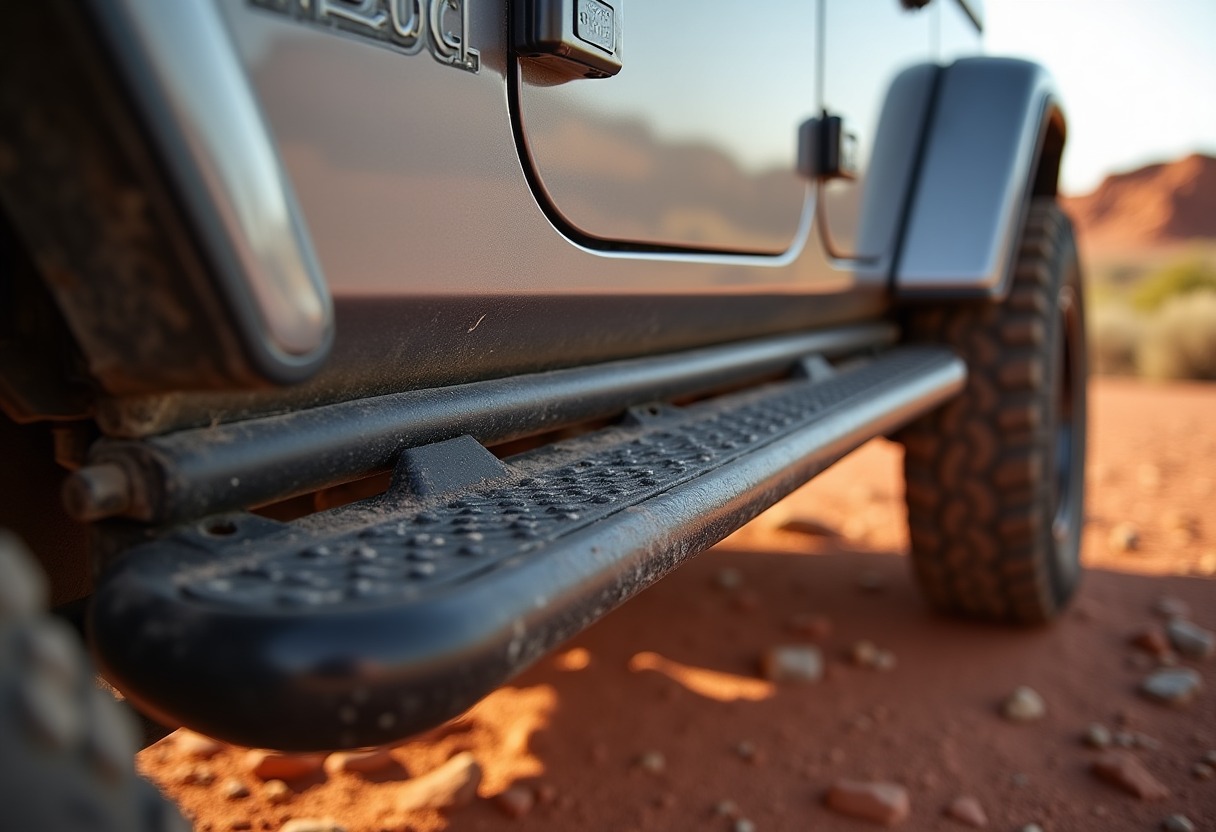
Your rocker panels take more hits than any other part of your Wrangler on technical trails. One wrong line over a boulder and you're looking at $1,200 in body panel damage — or a compromised tub that rusts from the inside out. Quality rock sliders turn that six-inch mistake into a scraping sound and nothing more.
The steel versus aluminum debate isn't about which material is "better" in absolute terms. Steel sliders weigh 30-50 pounds more per side but handle direct impacts without permanent deformation. Aluminum sliders save 60-100 pounds total but dent under the same hits that steel shrugs off. Your choice depends entirely on how you use your Rig and what you're willing to compromise.
Why Rock Sliders Matter More Than Running Boards
Running boards bolt to pinch welds and plastic clips. They're designed to support body weight getting in and out — maybe 300 pounds static load. Hit a rock at 5 mph with running boards installed and you'll fold them into your rocker panel, often taking the factory pinch weld with them.
True rock sliders mount directly to the frame with grade 8 bolts or welds. The load path runs from the slider tube through the mounting brackets into the frame rail, completely bypassing the body. When you slide across a rock, the frame absorbs the impact — exactly how Jeep designed the Wrangler's body-on-frame construction to handle abuse.
The engineering matters because rocker panels on JK and JL Wranglers are structural. They're not just cosmetic cladding. A collapsed rocker compromises door alignment, allows water intrusion into the cabin, and weakens the overall tub rigidity. Repair costs start at $800 for minor damage and exceed $3,000 when you need to cut and weld new metal into the body structure.
This is the same reason Best Jeep Wrangler Skid Plates 2026 focus on frame-mounted protection — the body can't be your armor.
Steel Rock Sliders: When Strength Beats Weight
DOM (drawn over mandrel) steel tubing dominates the rock slider market because it combines high yield strength with predictable deformation behavior. A 2-inch DOM tube with 0.120-inch wall thickness has a yield strength around 70,000 PSI. Under trail loads, steel bends elastically and returns to shape. When you exceed the elastic limit, steel yields gradually — you get a visible dent, not a catastrophic failure.
Cold-rolled steel sliders typically weigh 75-95 pounds per pair for JL Wranglers, 85-110 pounds for JK models. That extra weight sits low on the frame, actually improving center of gravity compared to roof-mounted gear. The real penalty comes in fuel economy — expect a 0.3-0.5 MPG reduction on highway driving from the added rotational mass and aerodynamic drag.
Steel's thermal properties matter in extreme conditions. The material holds powder coat better than aluminum, resists UV degradation, and tolerates weld repairs anywhere on the trail. If you crack a mounting bracket 200 miles from pavement, any welder can fix steel. You'll find welding equipment at ranches, municipal yards, and mining operations throughout the American West.
The primary weakness is corrosion. Untreated steel will rust through in 3-5 years in salt states. Quality manufacturers apply zinc-rich primer under powder coat, but any chip exposes bare metal. Expect to touch up paint annually if you run winter trails or live near coastlines.
→ Shop steel rock sliders jk jl on Amazon
Aluminum Rock Sliders: The Weight Savings Reality Check
6061-T6 aluminum tube yields around 35,000 PSI — roughly half of DOM steel. To achieve comparable strength, manufacturers use larger diameter tubes (often 3 inches) with thicker walls (0.188-inch typical). A properly engineered aluminum slider weighs 45-65 pounds per pair for JL models.
That 30-50 pound total weight savings matters most if you're building a long-range overland rig where every pound counts toward payload capacity. With a roof tent, full water storage, recovery gear, and camping equipment, you're already pushing GVWR on a stock Wrangler. Aluminum sliders free up 40 pounds for additional fuel or food storage.
The material doesn't rust. Aluminum forms a self-protecting oxide layer that prevents corrosion even with bare metal exposed. In humid climates or coastal regions, this single property justifies the material choice. You'll never spend a weekend sanding and repainting aluminum sliders.
The compromise shows up in dent resistance. Aluminum yields permanently under impacts that steel would bounce back from. A 15-mph slide across a granite edge will leave a flat spot in aluminum tube. The slider still functions — it protected your rocker — but the damage is permanent. Steel would show a scratch in the powder coat and nothing more.
Aluminum also can't be field-repaired with basic welding equipment. TIG welding aluminum requires clean material, proper shielding gas, and specific filler rods. If you're running remote trails in Mexico or Canada, you're not finding an aluminum-capable welder at a random shop.
→ Shop aluminum rocker guards on Amazon
Steel vs Aluminum: Direct Performance Comparison
| Criterion | Steel Rock Sliders | Aluminum Rock Sliders | |-----------|-------------------|----------------------| | Weight (JL pair) | 75-95 lbs | 45-65 lbs | | Impact Resistance | Bends elastically, returns to shape under typical trail impacts | Dents permanently but maintains structural function | | Corrosion | Requires powder coat maintenance, rust risk in salt environments | Forms protective oxide layer, essentially maintenance-free | | Field Repair | Any stick welder can repair cracks or broken brackets | Requires TIG welding with aluminum-specific equipment and skills | | Cost (quality sets) | $450-$800 | $550-$950 | | Powder Coat Durability | Excellent adhesion, UV stable, easy to touch up | Good adhesion but softer surface scratches more easily |
This is why serious rock crawlers choose steel and weight-conscious overlanders lean aluminum. If your typical weekend involves Moab slickrock or tight technical lines in Colorado, steel handles the repeated scraping without visible damage. If you're running the Trans-America Trail or building a long-distance expedition rig, aluminum's weight savings and corrosion resistance make more sense.
The material choice cascades into other decisions too — similar to how Ford Bronco Rock Sliders Steel Vs Aluminum affects overall build strategy for that platform.
Best Jeep Wrangler Rock Slider Types
Body-Mount Sliders
These bolt directly to the body pinch weld and tub, not the frame. They're a step up from running boards but shouldn't be trusted for serious rock contact. Body-mount sliders work fine for mall parking lots and gravel roads. On actual trails, they transfer impact loads into sheet metal that wasn't designed to handle side loads.
Frame-Mount Bolt-On Sliders
The minimum acceptable protection for trail use. These systems use 4-6 mounting points per side, bolting through the frame rail with grade 8 hardware. Installation takes 2-3 hours with hand tools. Quality bolt-on sliders from manufacturers like Metalcloak or LOD use gusseted brackets that distribute loads across 8-12 inches of frame.
The bolt-on design allows removal for paint, undercoating, or rust repair. You can also swap slider styles if you change how you use your Wrangler. The trade-off is slight flex in the mounting points under hard impacts — you'll see 1-2mm of movement at the bolts.
→ Shop bolt-on rock rails on Amazon
Weld-On Sliders
Maximum strength, zero compromise. Weld-on sliders become a permanent part of your frame. The mounting brackets get welded directly to the frame rail with multiple passes of penetration weld. Under impact, the entire frame rail acts as a structural member — no bolt flex, no bracket give.
Professional installation costs $400-$700 on top of slider price. You're committed to that slider design unless you're willing to cut it off and grind welds smooth. For rigs that live on trails rated 5+ difficulty, weld-on sliders are worth the permanence.
Slider-Step Hybrid Design
These add a 4-6 inch step surface on top of the main slider tube. The step helps with entry and exit, especially useful if you're running a 3+ inch lift. The compromise is ground clearance — you're adding 4-6 inches of width that can hang up on off-camber sections.
Hybrid designs work well for overlanders who need the accessibility but aren't threading narrow trail sections. They're less ideal for technical rock crawling where every inch of clearance matters. Consider your typical trail width before adding step surfaces that project beyond your tires.
→ Shop wrangler side step armor on Amazon
Installation and Fitment Details That Actually Matter
JK sliders (2007-2018) and JL sliders (2018+) are not interchangeable. The frame geometry changed significantly between generations. JL frames are fully boxed, providing better mounting surfaces but requiring different bracket designs. Always verify your model year before ordering.
Two-door and four-door Wranglers use different slider lengths. JKU and JLU sliders are typically 12-16 inches longer to cover the additional body length. Some manufacturers sell door-specific sliders, others offer one universal length that extends past the rear quarter on two-door models.
Mounting hardware quality separates good sliders from liability. Grade 8 bolts are non-negotiable — grade 5 hardware will shear under trail impacts. Nylock nuts prevent loosening from vibration. Torque specs typically range from 75-85 ft-lbs for main frame bolts. Check torque after the first 100 miles and again at 500 miles as mounting brackets seat into the frame.
Paint or powder coat should be removed from mounting surfaces where brackets contact the frame. Metal-to-metal contact prevents galvanic corrosion and ensures proper load transfer. Hit all exposed bolt threads with anti-seize compound rated for dissimilar metals.
This level of attention to mounting detail applies across armor systems — check our Best Jeep Wrangler Bumpers 2026 guide for similar installation standards.
What Most Guides Miss About Rock Slider Selection
Width matters more than most buyers realize. Sliders that sit flush with the body provide zero additional protection — they only protect the rocker panel itself. Sliders that extend 2-3 inches beyond the body provide "rock stance" that keeps the tub off obstacles. The trade-off is increased catch risk on narrow trails and slightly wider turning radius in parking lots.
Test the tube diameter against your boots before buying. If you plan to use the slider as a step, a 2-inch tube is uncomfortable to stand on for more than a few seconds. A 3-inch tube provides stable footing when you're wrenching on trail or cleaning the windshield.
Kicker location affects recovery options. Many sliders include a formed kicker at the rear quarter where they're most likely to take impacts. That's good engineering. But if the kicker interferes with Off Road Recovery Gear Every Jeep Owner Needs like bottle jacks or MaxTrax placement, the design creates new problems.
Check mounting bracket placement against your lift kit components. Some slider brackets interfere with aftermarket control arms or track bar relocation brackets. If you're planning suspension upgrades, coordinate slider selection with your lift kit choice — or reference How To Pick The Right Lift Kit to understand the interaction points.
Powder coat color matters less than you'd think on a trail rig. Black powder coat shows every scratch. Textured black or dark gray hides trail damage better. Some manufacturers offer raw steel with clear coat — it looks industrial but requires diligent rust prevention.
→ Shop jeep wrangler rock sliders on Amazon
FAQ
Do rock sliders affect Jeep Wrangler resale value? Quality frame-mounted sliders typically increase resale value by $300-$500 because they demonstrate proper trail preparation. Body-mount sliders or poorly installed weld-on systems can decrease value if they show frame damage or sloppy welding. Keep your installation receipts and photographs documenting proper torque specs.
Can I install rock sliders myself without welding experience? Bolt-on sliders require only basic hand tools — socket set, torque wrench, and possibly a drill for pilot holes. Expect 2-4 hours for first-time installation. Weld-on sliders require MIG or TIG welding skills and proper penetration into frame metal. If you can't produce consistent 3-inch weld beads, hire a professional fabricator.
Do aluminum sliders work for rock crawling or just overlanding? Aluminum sliders provide adequate protection for rock crawling — they'll save your rocker panels. They just show permanent dents where steel would spring back. If cosmetic damage bothers you, choose steel. If weight savings matter more than appearance, aluminum works fine even on hard trails.
How much ground clearance do rock sliders reduce? Frame-mounted sliders typically sit 0.5-1 inch below the frame rail, so they reduce clearance by that amount. Body-mount sliders often hang 2-3 inches below the frame, creating a significant low point. Measure from the ground to your frame rail, then compare to slider specs before buying.
Should I match rock slider finish to my other armor components? Powder coat color matching is aesthetic only — it doesn't affect function. Many builders run black sliders with bare aluminum bumpers or textured skid plates. If visual consistency matters for your build, order all armor from one manufacturer or specify matching powder coat colors. Most powder coat shops can match colors across different metal types.
Pick the Material That Matches Your Trails
Steel sliders dent less and cost less but weigh more and rust without maintenance. Aluminum sliders save weight and never corrode but show permanent damage and cost more upfront. Neither choice is wrong — both materials protect your rocker panels far better than running boards or nothing at all.
Some links on this page are affiliate links. We may earn a small commission if you purchase through them, at no extra cost to you.
As an Amazon Associate we earn from qualifying purchases. This article contains affiliate links; if you buy through them we may earn a small commission at no additional cost to you.