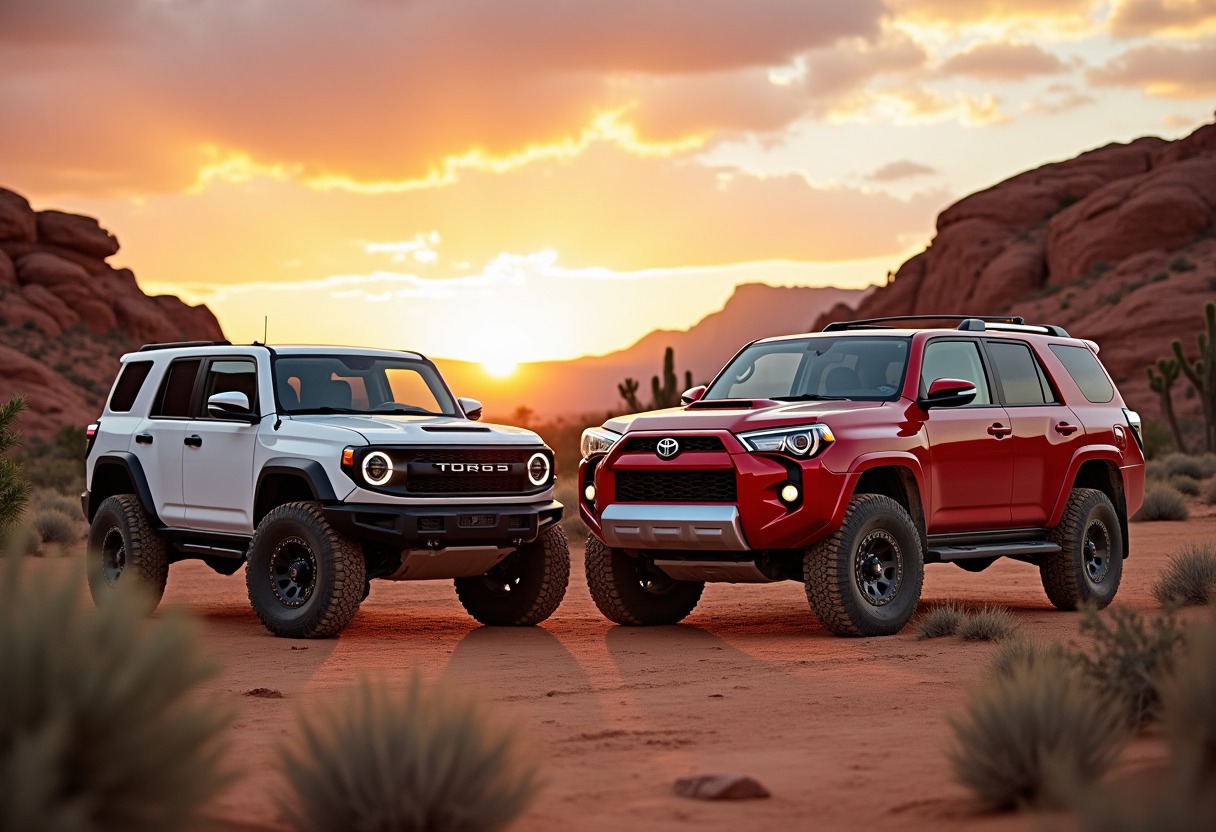
Both the Ford Bronco and Toyota 4Runner claim serious off-road credentials, but their approaches to conquering trails couldn't be more different. The Bronco brings modern tech and impressive articulation angles, while the 4Runner banks on proven mechanical systems and bulletproof reliability that overlanders have trusted for decades.
Why These Two Dominate Overlanding Conversations
The Bronco versus 4Runner debate splits the overlanding community because each vehicle represents a distinct philosophy. Ford's Bronco emerged in 2021 with advanced terrain management systems, independent front suspension, and class-leading approach angles. Toyota's 4Runner has remained mechanically unchanged since 2010, prioritizing proven V6 power delivery and time-tested 4WD systems over cutting-edge features.
According to Motor Trend's testing data, the Bronco's approach angle reaches 43.2 degrees in Sasquatch trim, while the 4Runner TRD Pro manages 33 degrees. However, ground clearance tells a different story—the 4Runner sits at 9.6 inches versus the Bronco's 11.6 inches, though this gap narrows when comparing stock configurations.
The aftermarket support ecosystem reveals where each vehicle truly shines for serious trail builders. Toyota's 15-year production run means mature, proven modification paths, while Bronco's rapid adoption has sparked intense development from armor and suspension manufacturers.
Performance Specifications That Matter on Trails
Real-world capability comes down to measurable factors that determine whether you clear that rock ledge or high-center on a root. The Bronco's independent front suspension provides better wheel travel and articulation compared to the 4Runner's solid front axle, but solid axles offer superior durability under repeated impacts.
Engine specifications reveal fundamental differences in power delivery philosophies. The Bronco's 2.7L EcoBoost produces 330 horsepower and 415 lb-ft of torque, while the 4Runner's 4.0L V6 generates 270 horsepower and 278 lb-ft. The EcoBoost's torque curve favors low-end grunt crucial for rock crawling, but turbo reliability concerns persist among overlanders planning extended remote expeditions.
Transmission options highlight each manufacturer's priorities. Ford offers both 7-speed manual and 10-speed automatic transmissions, giving drivers precise control over gear selection. Toyota's 5-speed automatic lacks the Bronco's gear density but provides proven reliability across hundreds of thousands of miles.
The 4Runner's transfer case operates through traditional mechanical linkages, while the Bronco employs electronic controls for terrain selection. Electronic systems respond faster and offer more precise torque distribution, but mechanical systems continue functioning when electrical components fail hundreds of miles from the nearest dealer.
| Specification | Ford Bronco Sasquatch | Toyota 4Runner TRD Pro | |--------------|----------------------|------------------------| | Ground Clearance | 11.6 inches | 9.6 inches | | Approach Angle | 43.2 degrees | 33 degrees | | Departure Angle | 37 degrees | 26 degrees | | Water Fording | 33.5 inches | 27.7 inches | | Wheelbase | 116.5 inches | 109.8 inches |
Reliability and Maintenance Considerations for Remote Travel
Long-distance overlanding demands vehicles that continue running when parts availability disappears and diagnostic computers become useless. The 4Runner's naturally aspirated V6 engine design eliminates turbo complexity, intercoolers, and boost-related failure points that could strand travelers in remote locations.
Toyota's reputation for mechanical durability stems from conservative engineering approaches that prioritize longevity over peak performance. The 4Runner's 4.0L engine runs timing chains instead of belts, reducing maintenance intervals and catastrophic failure risks. Ford's EcoBoost engines require more frequent service intervals and depend on turbo oil supply systems that add complexity to field repairs.
Parts availability heavily favors the 4Runner across most global markets. Toyota's international presence means finding replacement components in South America, Africa, and remote regions where Bronco parts networks remain limited. This factor alone influences many serious overlanders planning multi-continent expeditions.
The Bronco's electronic terrain management systems provide superior traction control and differential management, but electronic complexity introduces failure modes that don't exist in the 4Runner's simpler mechanical systems. When electronics fail on remote trails, mechanical backups determine whether you drive out or call for recovery.
Essential Modifications for Trail Performance
Both platforms benefit from targeted modifications that address their respective weaknesses. The Bronco's lower departure angle demands → Shop bronco skid plates on Amazon for underbody protection, while the 4Runner's limited approach angle benefits from aftermarket bumper replacements.
Rock sliders prove essential for both vehicles, though installation approaches differ significantly. Our detailed analysis in Ford Bronco Rock Sliders Steel Vs Aluminum covers material selection factors specific to Bronco mounting points. The 4Runner's frame design allows more straightforward slider integration with fewer clearance concerns.
Suspension modifications follow different paths due to fundamental architectural differences. The Bronco's independent front suspension limits lift options compared to solid axle conversions, but provides superior ride quality for daily driving. The 4Runner's solid front axle accepts larger lifts more easily, though ride quality degrades more rapidly with increased height. Check our guide on How To Pick The Right Lift Kit for platform-specific considerations.
Lighting upgrades prove crucial for both platforms during extended trail sessions. → Shop bronco roof rack on Amazon systems provide mounting points for auxiliary lighting arrays. The 4Runner's roof design accommodates similar setups with → Shop 4runner roof rack on Amazon options that integrate cleanly with factory mounting points.
Armor requirements differ based on each vehicle's vulnerable areas. The Bronco needs comprehensive skid plate coverage due to its lower-mounted components, while the 4Runner benefits more from strategic protection around the oil pan and transfer case. → Shop 4runner rock sliders on Amazon provide essential side protection for both platforms.
Advanced Capability Analysis Most Reviews Miss
Wheelbase differences create distinct handling characteristics that become apparent on technical terrain. The Bronco's longer wheelbase (116.5 inches versus 109.8 inches) provides stability on high-speed desert runs but reduces maneuverability in tight switchbacks and tree-lined trails. The 4Runner's shorter wheelbase allows tighter turning circles crucial for navigating narrow trail sections.
Weight distribution patterns affect traction characteristics under load. The Bronco carries more weight forward due to its turbocharged engine and associated cooling systems, while the 4Runner maintains more balanced front-to-rear distribution. This difference becomes noticeable when climbing steep grades with full expedition loads.
Cooling system capacity determines sustained performance capability during demanding climbs. The Bronco's turbo configuration requires more sophisticated cooling management, with additional heat exchangers that can become compromised by trail debris. The 4Runner's simpler cooling system proves more robust against rock damage but provides less performance headroom under extreme conditions.
Frame construction methods influence long-term durability under repeated stress cycles. The 4Runner's fully boxed frame design distributes loads more evenly compared to the Bronco's partially boxed construction. This difference matters most for builders planning heavy modification loads or extended expedition use.
Recovery point placement affects extraction capabilities when things go wrong. The Bronco's factory recovery points integrate better with aftermarket winch installations, while the 4Runner often requires modification for optimal recovery equipment mounting. Both platforms benefit from upgraded recovery hardware, as detailed in our Off Road Recovery Gear Every Jeep Owner Needs guide that applies equally to these platforms.
FAQ
Which vehicle handles desert running better, the Bronco or 4Runner? The Bronco's superior suspension travel and electronic stability systems provide better high-speed desert capability, with independent front suspension smoothing out rough terrain that would punish the 4Runner's solid axle setup. However, the 4Runner's proven cooling systems and simpler mechanical design reduce breakdown risks during extended high-temperature operation. The Bronco's longer wheelbase also contributes to stability at higher speeds across uneven surfaces.
How do maintenance costs compare between these platforms for overlanding use? Toyota's parts pricing runs significantly lower across most components, with oil changes, filters, and wear items costing 20-30% less than Ford equivalents. The 4Runner's longer service intervals (10,000 miles versus 7,500 for the EcoBoost) reduce maintenance frequency, while the Bronco's turbo system requires premium oil and more frequent changes. However, the Bronco's newer technology means fewer accumulated wear items initially, though long-term costs remain unknown.
Which platform offers better modification potential for serious trail use? The 4Runner's mature aftermarket ecosystem provides more proven modification paths, with 15 years of development creating extensive options for every component. The Bronco's rapid adoption has sparked intense manufacturer interest, resulting in innovative new products but fewer time-tested solutions. Solid axle swaps remain easier on the 4Runner platform, while the Bronco's independent suspension limits extreme modifications but provides better daily driveability.
How does real-world fuel economy compare during overlanding trips? The Bronco's turbo engine delivers better highway fuel economy (21 mpg combined versus 17 mpg for the 4Runner), but this advantage disappears during low-speed trail driving where both vehicles average 12-15 mpg. The 4Runner's larger fuel tank (23 gallons versus 22.3) provides slightly better range, though both platforms benefit significantly from auxiliary fuel storage for extended expeditions. Turbo engines typically consume more fuel under load compared to naturally aspirated alternatives.
Which vehicle handles expedition weight better when fully loaded? The 4Runner's higher payload capacity (1,440 pounds versus 1,370 pounds for the Bronco) provides more margin for expedition gear, camping equipment, and supplies. Both vehicles experience handling degradation when loaded to capacity, but the 4Runner's solid axle design maintains more consistent geometry under load. The Bronco's independent front suspension can develop alignment issues more readily when loaded beyond design parameters, requiring more careful weight distribution planning.
Choose the Bronco if you prioritize modern capability and don't mind complexity, or stick with the 4Runner if proven reliability and global support matter more than cutting-edge features.
Some links on this page are affiliate links. We may earn a small commission if you purchase through them, at no extra cost to you.
As an Amazon Associate we earn from qualifying purchases. This article contains affiliate links; if you buy through them we may earn a small commission at no additional cost to you.