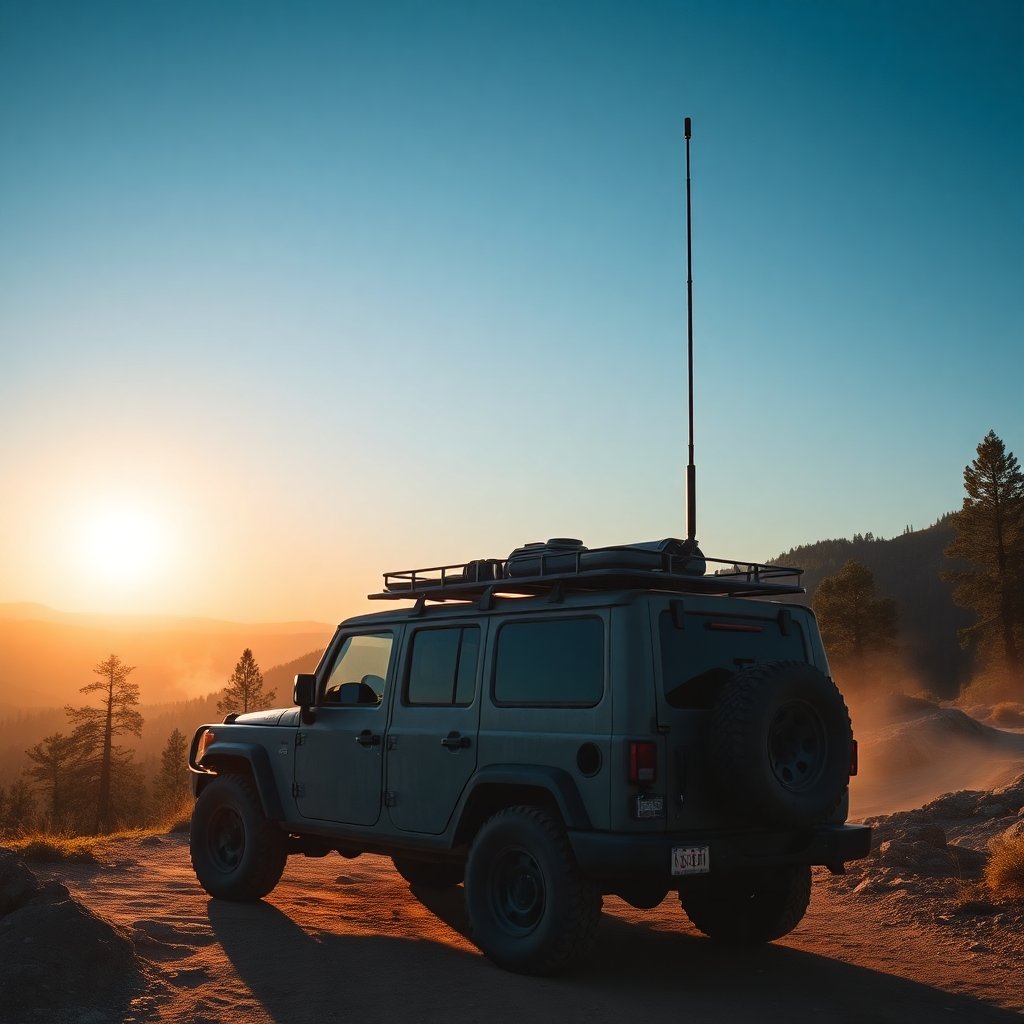
For decades the default trail radio was a CB, hissing away under the dash with a whip antenna bent over the hood. That era is ending. As convoys grow and cell coverage stays patchy in the backcountry, more overlanders are switching to GMRS, and 2026 is the year it became the obvious default rather than the enthusiast option. If you are wiring up a new rig this fall, GMRS is where the momentum, the gear selection, and the range now live.
This guide covers why the trail moved, what the license actually involves, how mobile and handheld radios differ, and which setups are worth buying. It pairs closely with the physical install, so if you have already run coax and mounted a bracket for a CB, most of that work carries straight over.
Affiliate disclosure: some links below are Amazon affiliate links. If you buy through them, this site may earn a small commission at no extra cost to you.
Why GMRS is winning over CB
The core problem with CB is power. Citizens Band is capped at 4 watts on AM, and that ceiling has not moved in decades. GMRS mobile radios are allowed up to 50 watts, and even a modest 15- to 20-watt unit clears ridgelines that leave a CB buried in static. More watts plus a higher, cleaner frequency band means the difference between a garbled "say again" and a crisp call to the rig three switchbacks behind you.
Audio quality is the other gap. CB rides on 27 MHz AM, which is noisy by nature. GMRS runs FM in the 462 to 467 MHz range, so transmissions come through clean until you hit the edge of range, then drop off rather than degrading into a slow wash of hiss. For a convoy trying to coordinate a tricky obstacle or a recovery, that clarity matters.
Then there are repeaters. A repeater sits on a high point, receives your signal, and rebroadcasts it across a much wider area. CB cannot use them at all. GMRS can, and in mountainous terrain a linked repeater can stretch usable range from a few miles to tens of miles. Right Channel Radios' overlanding radio guide walks through how much this changes group travel in real terrain.
The license: cheaper and simpler than people think
The one hurdle GMRS carries is a license, and it stops far more people than it should. The FCC charges 35 dollars, there is no exam, and the license is good for ten years. Better still, a single license covers your whole immediate family, so your spouse and kids can all transmit under one call sign. Compared to the amateur (ham) path, which requires passing a test, GMRS is close to friction-free.
Worth being clear about the rules: GMRS is licensed for a reason, and you are expected to identify with your call sign periodically. It is not a lawless free-for-all like CB, but for the average overlander the requirements are light and the payoff is real range and legal high-power operation.
Mobile vs handheld: pick based on how you travel
Mobile radios hardwire into the vehicle, draw from the 12-volt system, and drive an external antenna. This is where GMRS pulls decisively ahead of a handheld, because you get the full power allowance and a roof- or fender-mounted antenna that sits high and clear. The Midland MXT575 is the unit most builders reach for in 2026: it puts out a strong signal, handles repeaters, and installs cleanly with a compact control head. If you want a mobile setup that will actually reach your group across a valley, start here. → Shop GMRS mobile radios on Amazon
Handhelds are the low-commitment entry. A pair of 5-watt GMRS handhelds costs a fraction of a mobile install, needs no wiring, and rides in a door pocket. They are perfect for spotters guiding a driver over rocks, for a passenger jumping out to check a line, or as backups when the main radio fails. Range is limited by the short rubber antenna and low power, but for short-range trail chores they are hard to beat. → Shop GMRS handheld radios on Amazon
The honest answer for most builds is both: a mobile in the dash for convoy range, and a handheld or two for spotting and walkabout use. They share the same channels, so a spotter on foot talks straight to the driver.
The antenna matters more than the radio
This is the part people skimp on, and it is the single biggest lever on real-world range. A 50-watt radio feeding a stubby antenna underperforms a 20-watt radio feeding a good one mounted high. For GMRS you want an antenna tuned for the 462 to 467 MHz band, mounted as high and unobstructed as practical, whether that is a roof rack edge, a fender-mount bracket, or a hood ledge.
Cable quality and a solid ground plane matter too. A cheap thin coax bleeds signal before it ever reaches the antenna, so budget for decent cable and a clean metal mounting point. If you already ran coax for a CB, note that the connector and tuning differ, so plan on a GMRS-specific antenna rather than reusing the old whip. → Shop GMRS antennas and mounts on Amazon
How this fits your existing comms
GMRS does not replace everything else in the rig; it fills the mid-range convoy gap. Your phone and satellite gear handle true off-grid messaging and emergencies, while GMRS handles the constant chatter of a group on the move. If you run a satellite internet setup for camp, our Starlink Mini overlanding setup guide covers that side, and the two systems complement each other rather than overlap.
If you are coming from CB and want to understand the install mechanics, most of it transfers directly. The bracket, the routing, and the power tap are the same problems we covered in the Jeep Wrangler CB radio installation guide; you are mainly swapping the radio and antenna. And because a radio is part of your safety kit, it belongs alongside your other gear, which our off-road recovery gear rundown lays out in full.
What to buy for each budget
Spotter and backup setup. A pair of 5-watt GMRS handhelds. Cheap, no install, and genuinely useful the day they arrive. Good starting point if you are not sure you will use a radio enough to justify wiring one in.
The mainstream trail build. A Midland MXT575-class mobile radio plus a quality band-tuned antenna mounted high. This is the setup that clears ridgelines and reaches the back of a convoy, and it is what most serious overlanders land on in 2026. Expect to spend meaningfully more than a handheld pair, mostly justified by the antenna and the power.
The maximum-range build. A full 50-watt mobile radio, a premium antenna on the highest clean mount you have, and time spent learning your local repeater network. This is overkill for casual trail days and exactly right for remote group expeditions where losing contact is a real safety issue.
A few honest caveats
Range claims on packaging are optimistic. Real GMRS range depends heavily on terrain, antenna height, and obstructions, so treat "up to X miles" as a best-case line-of-sight figure, not a guarantee in timber or canyons. Repeater coverage also varies by region, and access sometimes requires permission from the repeater owner, so it pays to research your area before assuming coverage.
None of this replaces a proper emergency communicator for genuine backcountry solo travel, where a satellite messenger with an SOS function is the right tool. GMRS is for coordinating a group and reaching help within range, not for guaranteed rescue from a dead zone.
Bottom line
GMRS gives overlanders more power, cleaner audio, repeater reach, and a family-friendly license that costs less than a tank of fuel. For 2026 it has become the sensible default for trail comms, and the gear selection has finally caught up. Start with a mobile radio and a good antenna if you travel in groups, add a handheld or two for spotting, and keep your satellite gear for the true off-grid stretches. Get the antenna right and you will wonder why you tolerated CB static for as long as you did.
As an Amazon Associate we earn from qualifying purchases. This article contains affiliate links; if you buy through them we may earn a small commission at no additional cost to you.