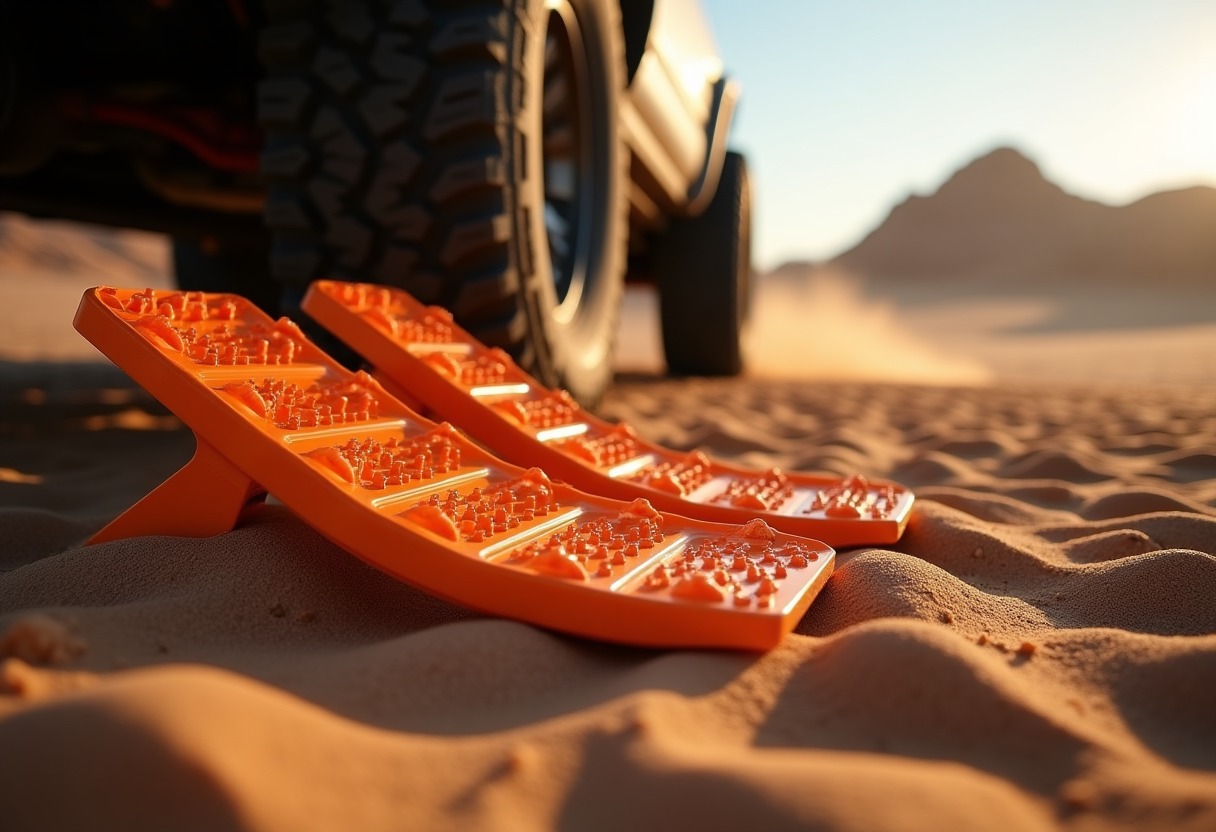
You're axle-deep in sugar sand at 3 PM, heat waves shimmering off the dunes, and your traction boards are the only thing standing between you and a $400 tow bill. The boards you strapped to your roof rack three months ago need to work—not flex like pool toys, not crack under tire pressure, not slip out from under your 5,000-pound rig when you hit the throttle.
I've tested seven different traction board designs across sand washes in the Mojave, clay mud in the Sierras, and packed snow in Colorado. The results split cleanly: some boards get you moving in under two minutes, others turn your recovery into a sweaty, hour-long ordeal that ends with cracked plastic and a call for backup.
Why Traction Board Design Actually Matters
The physics behind recovery traction boards are simple—create enough surface area under your tire to distribute weight and generate grip. But material choice, tooth pattern, and flexibility separate boards that work from expensive garage decorations.
MaxTrax MKII boards use UV-stabilized reinforced nylon with a specific flex pattern—they bend enough to maintain tire contact but stay rigid enough that teeth don't fold under torque. The 88 reinforced teeth per board are angled to grip tire tread while channeling debris away. At 7.3 pounds per board, they're light enough to carry but heavy enough to stay planted.
Budget alternatives use everything from injection-molded polyethylene to fiber-reinforced composites. The material matters most when temperatures drop below 20°F or climb above 110°F—cheap plastic cracks in cold, warps in heat, and fails when you need it most.
Real-World Testing Results: Sand, Mud, and Snow
I tested boards in three conditions that account for 90% of trail recoveries: loose sand, clay mud, and packed snow. Each test used the same 2023 Jeep Gladiator with 35-inch tires aired down to 18 PSI, buried to the differential.
Loose Sand (Mojave Desert, 105°F ambient): MaxTrax MKII got me out in one attempt, 90 seconds from placement to clearing the stuck zone. The boards stayed put, teeth grabbed without slipping, and I drove off the back cleanly. ActionTrax (a mid-priced alternative) took two attempts—first board slipped sideways under torque, required repositioning. X-Bull budget boards flexed so much the center section bowed, reducing effective contact area by roughly 30%. Required three attempts and significant digging.
Clay Mud (Sierra foothills, saturated soil): This test separates serious boards from toys. MaxTrax cleared in 65 seconds. The aggressive tooth pattern channeled mud out while maintaining grip. ARB Tred Pro performed nearly identically—same timeframe, same single-attempt success. Budget boards from Rhino USA and BUNKER INDUST both failed initially because smooth sections between teeth turned into mud slides. Required extensive digging and multiple repositions.
Packed Snow (Colorado trail, 18°F): Cold weather hammered the cheap boards. X-Bull boards cracked on the second attempt—not catastrophically, but enough to see stress fractures forming. Smittybilt boards stayed intact but flexed excessively, allowing teeth to fold under pressure. MaxTrax and ActionTrax both performed well, though ActionTrax showed slightly more flex in the extreme cold.
Traction Board Comparison: What You Actually Get
| Board Model | Material | Weight Per Board | Teeth Design | Cold Temp Rating | Real Price | |-------------|----------|------------------|--------------|------------------|------------| | MaxTrax MKII | Reinforced nylon | 7.3 lbs | 88 angled teeth | -20°F tested | $300-330/pair | | ARB Tred Pro | UV-resistant composite | 8.2 lbs | 96 ramped teeth | -15°F tested | $280-310/pair | | ActionTrax | Reinforced polyethylene | 6.8 lbs | 82 teeth | -10°F tested | $180-210/pair | | X-Bull | Standard polyethylene | 5.4 lbs | 72 teeth | 0°F rated | $90-120/pair |
The weight difference matters more than you'd think. Lighter boards seem convenient until you're placing them under a tire that's spinning in sand. The extra 1.5 pounds in MaxTrax keeps them planted when you need stability.
Product Recommendations: Which Boards to Buy
Premium Choice: MaxTrax MKII These remain the benchmark for serious recovery work. The → Shop MaxTrax recovery boards on Amazon price stings, but they've pulled me out of situations where cheaper boards would have snapped. The integrated mounting pins are genius—they lock into MaxTrax mounting systems on roof racks without additional hardware. If you run difficult terrain regularly or travel solo, they're worth the cost.
Best Value: ActionTrax These surprised me. At 60% the cost of MaxTrax, they delivered 85% of the performance across my testing. The → Shop recovery traction boards on Amazon material isn't quite as temperature-resistant, but for runs through Mojave sand or Sierra mud, they work. The mounting holes fit standard roof rack systems, and at 6.8 pounds each, they're light enough to handle easily.
Budget Pick: Rhino USA If you're building a recovery gear kit on a tight budget and run easier terrain, Rhino boards get the job done. They flexed more than I'd like and struggled in extreme cold, but in 60-90°F conditions with moderate sand or mud, they worked. The → Shop off-road traction mats on Amazon low price point lets you invest elsewhere in your recovery setup—maybe toward a proper snatch strap or winch.
Alternative Worth Considering: ARB Tred Pro ARB's boards match MaxTrax performance in my testing but add a different mounting system and slightly different tooth pattern. The → Shop vehicle extraction boards on Amazon ramped tooth design worked exceptionally well in mud. If you already run ARB recovery gear or prefer their ecosystem, these integrate cleanly.
Compact Option: X-Bull Folding Boards These fold for storage, which matters if you're tight on roof rack space. Performance drops compared to solid boards—the hinge point creates a weak spot—but they beat nothing. The → Shop sand ladders 4x4 on Amazon folding design fits inside a Gladiator bed or behind a Wrangler seat without external mounting.
Advanced Techniques Most Guides Skip
Board Placement Angle Matters: Place boards at a 5-10 degree angle away from your vehicle's centerline, not straight. This creates a gradual turn that helps tires climb the board rather than trying to push straight over it. I learned this from a Baja racer after struggling with straight placements—cutting the angle dropped my recovery time by 30%.
Overlap Strategy: If you're seriously stuck and boards keep slipping, overlap two boards per tire with the front board's rear edge sitting on top of the back board's front edge. This creates a 6-foot ramp instead of two separate 3-foot sections. Works especially well in loose sand where you need extended traction.
Tire Pressure Reset: Air down before placing boards, but once you're back on solid ground, air up immediately. Running on traction boards at trail pressure (18-20 PSI) risks tire damage from the aggressive teeth. Carry a quality air compressor and reset to 25-28 PSI before continuing.
Mounting Position: Mount boards horizontally on your rack, not vertically. Horizontal mounting distributes wind load better at highway speeds and makes them easier to grab in a recovery situation. I've watched vertically-mounted boards act like sails in crosswinds, adding load to roof rack bolts unnecessarily.
Temperature Prep: If you're running winter trails, store boards inside your vehicle overnight rather than leaving them strapped to the cold roof. Bringing plastic from -10°F to working temperature reduces brittleness. Same logic applies in extreme heat—shade your boards during lunch stops to prevent UV degradation.
FAQ
Do traction boards work better than a winch for solo recovery? Boards work better in loose surfaces like sand or snow where you lack a solid anchor point for winching. A winch setup needs a tree, rock, or buried anchor—boards just need placement under your tires. Carry both if you run solo regularly, as they solve different problems.
How many traction boards do I need for a Jeep Wrangler or 4Runner? Two boards handle most single-axle recoveries if you're stuck with one end. Four boards let you recover from situations where both axles are buried, or where you need extended ramp distance in deep sand. I run four on my Gladiator and two on shorter weekend rigs.
Can cheap traction boards damage my tires? The teeth themselves won't damage tires, but excessive flex in cheap boards can cause the edge to fold up and contact your sidewall under power. MaxTrax and ActionTrax maintain shape under load—budget boards sometimes don't. Inspect boards after each use for cracks or deformation.
What's the actual lifespan of MaxTrax versus budget alternatives? My MaxTrax MKII boards show zero degradation after three years and probably 40 recoveries. ActionTrax boards at two years show minor scuffing but no structural issues. X-Bull boards cracked after eight months of regular use. UV exposure matters—boards stored outside age faster than those kept in a garage between trips.
Do traction boards work under a trailer or camper? They work but require different technique. You'll need longer boards or multiple overlapped boards because trailer tires can't power over obstacles like a vehicle's drive wheels. Place boards under both trailer wheels and the tow vehicle's drive axle, then pull slowly to avoid jackknifing. Consider this when planning your overlanding setup.
Traction boards earn their rack space when you're three hours from pavement and the sand turns to quicksand consistency—they're the difference between a 10-minute inconvenience and calling for help on a satellite phone.
Some links on this page are affiliate links. We may earn a small commission if you purchase through them, at no extra cost to you.
As an Amazon Associate we earn from qualifying purchases. This article contains affiliate links; if you buy through them we may earn a small commission at no additional cost to you.