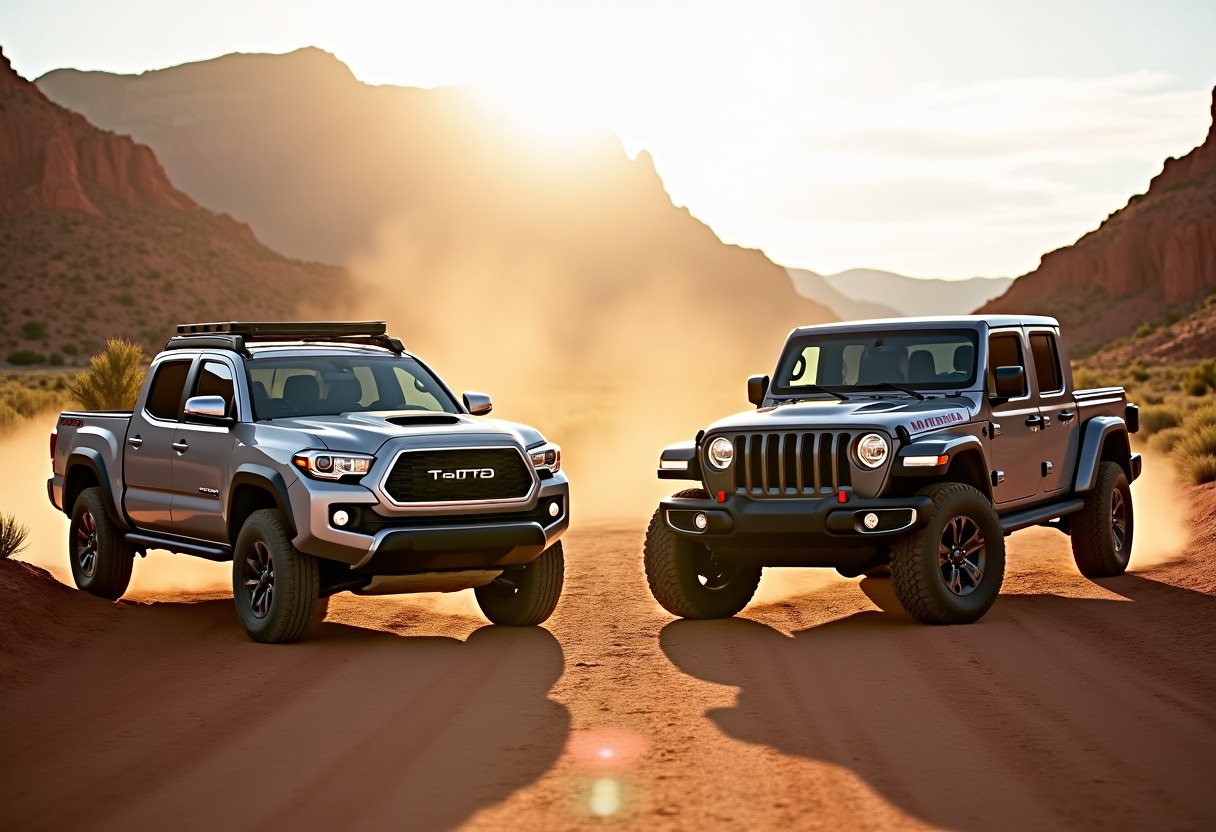
The Tacoma and Gladiator both promise mid-size truck capability with serious off-road credentials, but they take wildly different approaches to the same problem. One's a body-on-frame workhorse refined over decades of trail abuse, the other's a Wrangler with a bed — which matters more than you'd think when you're planning a 2,000-mile overland route with 800 pounds of gear.
Why This Comparison Matters for Overlanders
Most truck comparisons stop at towing capacity and bed length. That's useless for overlanding, where payload becomes your limiting factor the moment you bolt on a roof rack, bumpers, sliders, and start loading water, recovery gear, and camp equipment. The 2024 Toyota Tacoma offers payload ratings between 1,155 and 1,685 pounds depending on configuration. The Gladiator sits at 1,700 pounds max for the Sport trim but drops to 1,043 pounds on the Rubicon — the one you actually want for trails.
Beyond the spec sheet, these trucks handle armor, daily driving, and trail geometry completely differently. The Gladiator's removable doors and fold-down windshield appeal to Wrangler loyalists who prioritize articulation and approach angles over highway stability. The Tacoma offers better fuel economy (18/22 mpg combined vs 16/22 mpg), a quieter cabin above 65 mph, and a parts ecosystem built on thirty years of continuous development.
Both have loyal followings for good reasons, but your decision hinges on three factors: how much weight you're actually carrying, what armor you need to bolt on, and whether you can tolerate the Gladiator's highway manners five days a week.
Payload Reality: What the Numbers Actually Mean
Payload capacity on paper doesn't account for aftermarket modifications. Start with base numbers:
Toyota Tacoma TRD Off-Road:
- Base payload: 1,175 lbs (Double Cab, short bed)
- After typical mods: ~900 lbs usable
Jeep Gladiator Rubicon:
- Base payload: 1,043 lbs
- After typical mods: ~750 lbs usable
"Typical mods" here means steel front bumper with winch (150 lbs), steel rear bumper (100 lbs), sliders (120 lbs), bed rack (80 lbs), roof rack (60 lbs), skid plates (40 lbs), and 35-inch tires with heavier wheels (80 lbs over stock). That's 630 pounds before you load a single piece of camping gear.
If you're running a truck bed rack system, you need to account for the rack weight plus whatever you're mounting — roof top tent (150 lbs), awning (50 lbs), jerry cans (40 lbs each when full), recovery boards (20 lbs). Two people, camping gear for a week, food, water, and spare parts easily hit 400-500 pounds. You're bumping against limits before you add luxuries.
The Tacoma's advantage isn't huge here, but 150 pounds of usable payload matters when you're deciding whether to bring a second spare or more water. The Gladiator Overland trim with its 1,700-pound payload looks better on paper, but you lose the Rubicon's lockers and disconnecting sway bar — exactly what you bought a Gladiator for.
Armor and Protection: Fitment and Options
Both trucks have mature aftermarket support, but the ecosystems developed differently.
Gladiator Armor: The Gladiator shares most hard points with the JL Wrangler, which means bumpers, sliders, and skid plates designed for the Wrangler often adapt directly. Companies like LOD, Poison Spyder, and Metalcloak offer Gladiator-specific versions of their popular Wrangler bumpers with adjustments for the longer wheelbase. Sliders need to be Gladiator-specific because the bed changes mounting points — you can't use JL sliders.
The Gladiator's body-side fuel tank (not bed-mounted) means you need dedicated fuel tank skid protection that Tacoma owners don't think about. → Shop mid-size truck rear bumper on Amazon for options that include tire carrier integration — critical for the Gladiator since you need to relocate the spare when you upgrade to 35s or 37s.
Tacoma Armor: Third-generation Tacomas (2016-2023) have had a decade to develop an aftermarket. CBI, Dissent, Shrockworks, and Coastal Offroad make truck-specific bumpers that account for the Tacoma's different frame geometry and approach angles compared to the 4Runner. The newer fourth-gen Tacoma (2024+) reset the ecosystem, but major manufacturers already offer rock sliders and front bumpers.
Tacoma skid plates protect a different set of vulnerable points — the integrated cat converter sits lower than you'd expect, and you absolutely need coverage there in rocky terrain. Factory skid plates are aluminum and work fine for dirt roads but fold like foil on sharp ledges.
| Feature | Tacoma TRD Off-Road | Gladiator Rubicon | |---------|---------------------|-------------------| | Aftermarket bumper availability | Extensive (3rd gen), Growing (4th gen) | Extensive (shares JL ecosystem) | | Slider mounting | Frame-mounted, bolt-on standard | Frame-mounted, bed complicates design | | Skid plate coverage needed | Engine, transmission, transfer case, fuel tank, cat converter | Engine, transmission, transfer case, body-mounted fuel tank, diff | | Average armor weight penalty | 410 lbs (full protection) | 430 lbs (full protection) |
Both trucks benefit from quality skid plates — don't cheap out with thin aluminum that tears on the first rock strike.
Trail Performance: Angles, Breakover, and Wheelbase
The Gladiator's Wrangler DNA shows up in the numbers. Factory Rubicon specs: 43.6° approach, 20.3° breakover, 26° departure, with a 137.3-inch wheelbase. The Tacoma TRD Off-Road: 29° approach (32° with TRD Pro), 23.9° breakover, 23.5° departure, with a 140.6-inch wheelbase on the Double Cab.
That approach angle difference matters less than you'd think once you install an aftermarket bumper — both trucks end up in the low-to-mid 30s with a winch-capable front bumper. Breakover is where the shorter Gladiator cab makes a difference on ledges and steep transitions. The Tacoma's slightly longer wheelbase helps stability on off-camber sections but increases your three-point moments on technical obstacles.
Real-world advantage goes to the Gladiator on tight, technical trails with sharp transitions. The Tacoma wins on fast washboard and sustained climbs where suspension travel and stability matter more than pure geometry.
Daily Driving: The 90% Use Case Nobody Admits
Unless you live on a ranch or run trails every weekend, your overland truck spends most of its time commuting, running errands, and highway trips. This is where the Tacoma pulls ahead decisively.
The Gladiator's solid front axle and recirculating ball steering create constant corrections above 60 mph. Wind gusts move you around. Passing trucks require attention. The ride is choppy on expansion joints. If you grew up in Wranglers, this feels normal. If you're coming from a 4Runner or Frontier, it's fatiguing on six-hour highway runs.
The Tacoma's independent front suspension (IFS) tracks straight with minimal input. Cabin noise at 70 mph measures noticeably quieter — you can have a conversation without raising your voice. Fuel economy on premium (required for the newer turbocharged engines) still beats the Gladiator's V6 on regular unleaded for overall cost per mile.
Neither truck rides like a Tundra or a half-ton, but the Tacoma doesn't beat you up on pavement the way the Gladiator does. If your overland trips are quarterly and your commute is daily, this matters.
What to Bolt On First: Essential Mods for Both Platforms
Start with protection and recovery before you add comfort or aesthetics. Both trucks need:
Immediate Priority:
- → Shop truck cab roof rack on Amazon — distributes weight better than bed-only racks, protects cab from shifting cargo
- Quality sliders bolted to the frame, not body-mounted cosmetic steps
- Front recovery points — factory vs aftermarket options apply here too
- Skid plate set covering transfer case and vulnerable components
- → Shop bed-mounted recovery boards on Amazon — MaxTrax or similar, mounted where you can actually reach them
Phase Two (After First Trip):
- Upgraded suspension matched to loaded weight — stock springs sag with armor and gear
- Communication (radio mount, antenna)
- Lighting — LED light bars for camp and trail navigation
- Tire upgrade to 33s (Tacoma) or 35s (Gladiator) with appropriate regearing
The Gladiator can run 35s on factory gears and clearance with minimal modification. The Tacoma needs a lift kit and potentially regearing to run 35s without strain. This is a real cost difference if you're planning serious tire upgrades.
Storage and Camp: Both trucks benefit from bed organization systems, but approach differs. The Gladiator's shorter bed (5 feet) makes drawer systems less useful — you need vertical storage solutions. The Tacoma's 5-foot or 6-foot bed allows for full-width drawer setups that still leave room for longer items like shovels and traction boards.
If you're considering a bed-mounted camper setup, the Tacoma's higher payload capacity gives you more options without exceeding GVWR. The Gladiator works with ultralight popup campers but struggles with traditional hard-side units.
The 1,000-Mile Reality Check
Three factors determine which truck works for your actual usage pattern:
Choose the Gladiator if:
- Your trails prioritize tight technical sections over fast desert running
- You value the Wrangler's removable top and doors for summer trips
- Highway comfort isn't a priority and you prefer solid axle articulation
- You already own Wrangler accessories that cross over
- You plan to run 35-inch or larger tires without major suspension work
Choose the Tacoma if:
- Your overlanding includes significant highway transit between trail sections
- You need maximum payload for heavy gear, dual batteries, or camp systems
- Daily driving comfort matters for work-week use
- You want better fuel economy on long-range trips
- Your priority is reliability data — Tacomas have thirty years of proven durability records
Neither truck is wrong. The Gladiator doubles down on extreme capability and Jeep heritage. The Tacoma offers a more balanced package that excels at the 90% use case while still handling serious trail work.
Frequently Asked Questions
Which has better aftermarket support for overlanding mods? Both platforms have strong aftermarket ecosystems, but they developed differently. The Gladiator benefits from JL Wrangler parts compatibility for bumpers, winches, and lighting, giving it instant access to a mature catalog. Tacomas have model-specific parts refined over decades, particularly for the third-generation trucks (2016-2023). The new fourth-gen Tacoma (2024+) is building its ecosystem now, so early adopters have fewer immediate choices. For overlanding specifically — racks, armor, recovery — both have everything you need from major manufacturers. Edge goes to Gladiator for pure volume of available options, but Tacoma parts often cost 10-15% less for equivalent quality because of higher competition.
Can the Gladiator Rubicon actually use its 1,043-lb payload for overlanding? Only if you're extremely selective with mods and gear. That 1,043-pound rating assumes stock configuration. A realistic armor and camping setup looks like this: steel front bumper with winch (150 lbs), steel rear bumper (100 lbs), sliders (120 lbs), bed rack (80 lbs), RTT (150 lbs), skid plates (40 lbs), 35-inch tires and wheels (80 lbs over stock), recovery gear (60 lbs), camp equipment and food for two people one week (300 lbs), water (100 lbs for 12 gallons). That's 1,180 pounds before you add passengers. You'll exceed GVWR with a full build, which affects handling and warranty coverage. The Gladiator Overland's 1,700-lb payload makes more sense for serious builds, but you lose the Rubicon's lockers.
How does the Tacoma's IFS compare to the Gladiator's solid front axle off-road? Independent front suspension on the Tacoma provides better on-road handling and absorbs small chop more smoothly, but limits articulation compared to a solid axle. When a Gladiator's front wheel drops into a hole, the opposite wheel stays planted — the axle pivots as a unit. The Tacoma's IFS can't match that articulation without significant suspension travel, which is why it relies on traction control and brake-based limited slip to compensate. In practice, modern IFS with good shocks and geometry handles most overlanding situations without issue. The solid axle advantage shows up most in extreme rock crawling with steep cross-axle situations. For overlanding mixed terrain — dirt roads, moderate trails, washboard, some technical sections — the performance difference is smaller than forums suggest, and the Tacoma's IFS makes everything else more comfortable.
Which truck costs less to build into a capable overlander? Initial purchase price favors the Tacoma by $3,000-$5,000 for comparable trim levels (TRD Off-Road vs Rubicon). Modification costs run nearly identical for armor and protection — both need bumpers, sliders, and skids in the same price ranges. The difference appears in tire upgrades and suspension. The Gladiator runs 35-inch tires on stock suspension and gearing without issues. The Tacoma needs a 2.5- to 3-inch lift ($1,200-$2,500 installed) and potentially regearing ($1,800-$2,400) to run 35s properly, though many run 33s without regearing. If you're planning to stay on 33s or smaller, costs equalize. For 35s and above, the Gladiator saves $2,000-$4,000 in required supporting mods. Fuel costs over time favor the Tacoma slightly — figure $200-$300 per year difference for 12,000 miles of mixed driving.
What's the real-world reliability difference for extended trips? Toyota's reputation for reliability isn't just marketing — independent data from sources like MotorTrend's long-term tests consistently show fewer unscheduled maintenance events for Tacomas over 100,000 miles. The third-gen Tacoma's 3.5L V6 has proven extremely durable, though the newer turbocharged four-cylinder in 2024+ models doesn't yet have long-term data. The Gladiator's 3.6L Pentastar V6 is reliable but has documented oil consumption issues in some model years and requires more frequent maintenance intervals. For remote overlanding where the nearest dealer might be 500 miles away, the Tacoma's simpler drivetrain and longer service intervals (10,000 miles for oil changes vs 8,000 for the Gladiator under severe service) reduce stress. That said, both trucks will complete multi-week trips without issue if properly maintained. The difference shows up in 5-10 year ownership where Tacomas typically need fewer repairs.
The Real Decision Point
You're not choosing between a good truck and a bad truck — you're choosing which compromises you can live with. The Gladiator compromises daily comfort for maximum trail capability and Jeep heritage. The Tacoma compromises extreme articulation for better all-around performance. Both will get you deep into the backcountry and home again. The winner is whichever one you'll actually drive five days a week without regretting the purchase.
Some links on this page are affiliate links. We may earn a small commission if you purchase through them, at no extra cost to you.
As an Amazon Associate we earn from qualifying purchases. This article contains affiliate links; if you buy through them we may earn a small commission at no additional cost to you.